BY DOUGLAS VAHIA
The people of Guadalcanal and Solomon Islands are still suffering the deadly consequences of World War II, with unexploded bombs and other war remnants continuing to threaten lives and hamper development more than eight decades after the Guadalcanal Campaign.
Guadalcanal Province Premier Willie Atu, speaking during the Battle of Bloody Ridge Commemoration said Solomon Islanders are still living with the dangerous ‘remnants’ or ‘leftovers’ of the war fought on the island more than 80 years ago.
“80 years on the people of Guadalcanal and Solomon Islands for that matter, are still suffering from your remnants,” he said.
The Premier pointed to the tragic Mother’s Day barbecue incident in May 2021, when an unexploded wartime ordnance caused the deaths of two young Solomon Islands professionals, both university graduates.
A young woman also lost a limb in the incident and has since had to depend on daily support from relatives and friends.
Following the tragedy, she established the local association Bomb Free Solomon Islands to raise awareness of the continuing dangers posed by unexploded ordnance (UXO).
Atu said the UXO problem is also placing a heavy financial burden on Guadalcanal Province and affecting the implementation of infrastructure projects.
He explained that infrastructure development, particularly in areas close to Honiara, require UXO assessment surveys before construction can proceed.
“These have costed us millions of dollars,” he said, arguing that the money could otherwise be used to build another clinic or classroom for rural communities in Guadalcanal.
Atu further warned that the danger is not diminishing with time.
He referred to a study conducted by the University of Queensland in Australia and funded by the Government of Japan through the United Nations Development Programme (UNDP), which found that the danger is increasing as unexploded bombs continue to decay.
Communities have also reported illnesses that may be linked to exposure to toxins from deteriorating wartime ordnance.
According to figures cited in the speech, Solomon Islands Police recorded 7,773 unexploded-bomb callouts between 2011 and 2025, highlighting the scale of the problem that continues to confront communities.
Atu also warned that climate change is adding another layer of danger.
Flooding, storms and coastal erosion can expose buried bombs, accelerate their corrosion and potentially spread contaminated sediments into wells, rivers and coastal reefs.
He said increasingly acidic seas could also accelerate the release of chemicals from the deteriorating explosives.
The environmental and health consequences of the war are therefore continuing to unfold, with heavy metals such as lead, arsenic, cadmium and mercury found at sites where bombs and explosives are located.
As Solomon Islands continues to commemorate the sacrifices and battles of the Guadalcanal Campaign, the Premier stressed that the war’s legacy is not confined to history.
“Out there, people’s lives are still at risk and danger from that war fought here on our shores eighty years ago,” he said.
His remarks underscored a continuing challenge for Solomon Islands: while the country remembers the historic battles and honours those who fought and died, communities are still confronting the dangerous and costly leftovers of that conflict.
For Guadalcanal, the legacy of World War II remains not only in memorials and historical sites, but also beneath the ground, in the form of unexploded bombs that continue to threaten lives, the environment and development.
Australia, the United States, Japan, New Zealand, Canada, the United Kingdom, and the Republic of Korea (South Korea) have all actively participated in international efforts to remove unexploded ordnance (UXO) in the Solomon Islands.
These countries contribute through multinational military clearance exercises, direct financial grants, and training programs to build local capabilities.
Australia initiated and continues to lead Operation Render Safe, a recurring regional defence force operation dedicated to locating and safely destroying World War II-era remnants.
Australia also co-founded a joint assistance initiative to build up the Royal Solomon Islands Police Force (RSIPF) Explosive Ordnance Disposal (EOD) unit.
United States has invested tens of millions of dollars since 2009 in weapons destruction activities. The US funds specialised technical groups, provides millions in grants to international demining NGOs like The HALO Trust, and supports the training of local EOD personnel.
Japan focuses heavily on capacity building and infrastructure. The Government of Japan provides financial grants to procure specialised machinery, excavators, and landing craft specifically designed to safely transport UXOs across islands. The Japan Ground Self-Defense Force also runs regional training and public awareness operations.
New Zealand, Canada, and the United Kingdom have deployed expert military explosive clearance teams and specialised personnel directly to the field during large-scale operations like Operation Render Safe.
Republic of Korea joined as an active participant in major multinational UXO clearance operations alongside the RSIPF.
For feedback, contact: diivee56@gmail.com
Editor: irwin3angiki@gmail.com
PRC delivers 22 water tanks to West Makira schools and communities to improve access to clean drinking water. The People’s Republic of China (PRC) has delivered 22 water tanks to West Makira Constituency to support access to clean drinking water for schools and communities. The tanks were formally handed over during a brief event at [...]
The post 22 Water Tanks Delivered to Support West Makira Schools and Communities appeared first on Tavuli News (Solomon Islands) .
BY RICHARD MENANOPO
Grassroots sport development in Makira-Ulawa province has received a boost after 60 school and sports representatives completed the province’s first Oceania Sport Education Programme (OSEP) and Physical Education (PE) training in Kirakira.
The five-day programme, held from August 29 to September 2, was delivered by the National Sports Council (NSC) in partnership with the Ministry of Education and Human Resources Development (MEHRD) and Solomon Islands National University (SINU).
The training brought together school leaders from seven local schools, alongside representatives from the province’s rugby, netball, volleyball and football associations.
OSEP and PE participants engage in practical training and activities during the first programme delivered in Makira-Ulawa Province.
Rather than focusing solely on sporting skills, the programme targeted the people responsible for developing and managing sport at school and community level.
Participants were introduced to areas including sports governance, coaching, athlete development, event organisation, risk management, child safety and the establishment of sustainable sporting clubs.
The programme combined classroom sessions with practical exercises, allowing participants to test coaching techniques, plan community sporting activities and receive feedback from facilitators and fellow participants.
Makira-Ulawa Provincial Government Minister for Community Governance, Youth and Sports Daniel Dautaha welcomed the initiative, saying grassroots sport remained an important foundation for national sports development.
OSEP and PE participants engage in practical training and activities during the first programme delivered in Makira-Ulawa.
“Grassroots sport is the foundation of sports development in our country,” Dautaha said.
He encouraged participants to take the knowledge gained from the programme back to their schools and communities and use it to create more opportunities for young people to participate in sport.
NSC officials said the training was designed to strengthen the capacity of teachers, coaches, administrators, team managers and community sports leaders.
OSEP Master Educator and NSC Education Manager Atueta Balekana said the response from participants demonstrated the value of taking practical sports education into the provinces.
“The response from the participants shows the importance of bringing practical sports education and capacity building closer to our provinces and communities,” Balekana said.
Participants take part in an outdoor practical session during the first OSEP and PE programme in Makira-Ulawa Province.
The programme also promoted greater coordination between education and sport, with participants exploring ways to organise safe, enjoyable and sustainable activities for their communities.
The group included 48 women and 12 men, while two participants — one male and one female — were persons with disabilities.
NSC Provincial Sports and Recreational Supervisor Carlson Hagemana and Sports and Recreational Development Coordinator for Makira-Ulawa Edward Quiroquiro joined Balekana in facilitating the programme.
The completion of the Makira-Ulawa programme marks the beginning of a wider provincial sports capacity-building rollout by NSC.
Similar programmes are planned for Isabel, Western and Central Islands provinces in the coming weeks as the Council continues efforts to strengthen grassroots sport and physical activity across Solomon Islands.
The initiative is aimed at ensuring provincial teachers, coaches and sports administrators have the practical skills needed to develop sport from the community level upwards.
For feedback, contact: mnorichard4@gmail.com
Editor: irwin2angiki@gmail.com
BY NED GAGAHE
JAPAN has provided JPY430 million (about US$3 million) to support electoral and democratic governance programmes in Solomon Islands.
The funding was provided to the United Nations Development Programme (UNDP) for the Solomon Islands Democratic Governance and Electoral Assistance Project (SIDGEAP).
The contribution was formalised at a signing ceremony held at the Embassy of Japan in Honiara today.
It was attended by Japan’s Ambassador to Solomon Islands, Keiichi Higuchi, UNDP Resident Representative for the Pacific Office Munkhtuya Altangerel, and Chief Electoral Officer of the Solomon Islands Electoral Commission (SIEC), Jasper Highwood Anisi.
Japan’s Ambassador to Solomon Islands Keiichi Higuchi, UNDP Resident Representative for the Pacific Office Munkhtuya Altangerel, and SIEC Chief Electoral Officer Jasper Highwood Anisi attended the signing ceremony. Photo by Ned Gagahe.
The project is being implemented in partnership with SIEC and the Office of the Registrar of Political Parties (ORPP).
It is aimed at strengthening electoral institutions and supporting preparations for future elections that are inclusive, transparent and credible.
Ambassador Higuchi said free, inclusive and fair elections were essential to a stable democracy.
He said the successful delivery of the 2024 Joint Elections had earned praise for their transparency and credibility.
“Indispensable to any stable democracy is an election that is free, inclusive, and fair,” he said.
Ambassador Higuchi said Japan would work with UNDP and SIEC to strengthen facilities, provide technical training and expand civic education.
Japan’s Ambassador to Solomon Islands Keiichi Higuchi and UNDP Resident Representative for the Pacific Office Munkhtuya Altangerel sign the agreement, as SIEC Chief Electoral Officer Jasper Highwood Anisi looks on. Photo by Ned Gagahe.
He said the assistance would help ensure future elections, including the 2028 General Elections, were transparent, inclusive and trusted by citizens.
UNDP Resident Representative Munkhtuya Altangerel welcomed Japan’s contribution, saying it would build on lessons learned from the 2024 Joint Elections.
She said the support would help Solomon Islands improve its institutional, legal and operational readiness well before the next general election.
“Together, we are committed to accountable institutions and inclusive participation led and owned by Solomon Islanders,” she said.
Chief Electoral Officer Jasper Highwood Anisi said Japan’s assistance would help build on the credibility of previous elections.
He said the support would position SIEC to conduct future by-elections and the 2028 General Elections with greater transparency and inclusiveness.
Mr Anisi said reforms and innovations were being developed under SIEC’s Strategic Plan.
He said the aim was to ensure women, young people and persons with disabilities were not only participants in the democratic process but also leaders in shaping the country’s democratic future.
The new Japanese contribution also expands the group of development partners supporting the UNDP-led programme.
Japan joins Australia and the United Kingdom in supporting the current programme, while the European Union provided assistance during the previous electoral cycle.
Ambassador Keiichi Higuchi, SIEC CEO Jasper Highwood Anisi and UNDP Resident Representative Munkhtuya Altangerel in discussion before the signing at the Japanese Embassy. Photo by Ned Gagahe.
The partnership reflects Japan’s foreign policy priorities, including human security and a Free and Open Indo-Pacific.
Japan also has a longstanding partnership with UNDP in areas including governance, resilience and community safety.
The partners said cooperation would continue beyond the 2028 elections to support nationally led efforts to strengthen electoral institutions, promote inclusive participation and build public confidence in electoral processes.
The signing ceremony was moderated by UNDP Solomon Islands Programme Specialist for Inclusive Governance and Economic Growth, Solomon Kalu.
For feedback, contact: nedgagahe@gmail.com
Editor: irwin2angiki@gmail.com
by Ednal Palmer Students at Gifu Primary School in the remote Barana highlands of Guadalcanal have welcomed a new water,...
The post New WASH Facility Brings Relief to Gifu Primary School appeared first on In-depth Solomons .
BY TONY IROGA
PRIME Minister Matthew Wale has revealed that the proposed roll-out of free education from Early Childhood Education (ECE) through to Solomon Islands National University (SINU) and TAFE carries an additional estimated cost of $1.1 billion.
Mr Wale made the revelation in Parliament yesterday when he moved for the House to adjourn sine die, saying the Government has serious concerns about some of the assumptions and foundations used in the costing.
“We have a total costing that the ministry had given, which is $1.1 billion of extra money just for the free education roll-out from ECE to SINU and TAFE.
“We have serious questions on some of the premise, the foundations of the costing, and so we have given back to the sector, ministry and plus the sector to look at it so that what is going in the budget is what we see as realistic and reasonable and the administrative tools and instruments to implement,” Mr Wale said.
Wale said the Government is waiting for the ministry and relevant sectors to review the figures before the matter returns to Parliament.
“Once we are clear on it, we will have a bipartisan discussion about what is in and what is not in before it comes back to the House,” he said.
PM Wale also praised the work of the Public Accounts Committee (PAC), saying the committee plays an important role in parliamentary oversight.
“I am really pleased with the efficiency with which the Chairman runs the Public Accounts committee,” Wale said.
He said sufficient time must be provided for the PAC to scrutinise the budget and for ministries to appear before the committee to explain their work programmes.
“We want to forward the budget and have ample time for the PAC to do its work and for the ministries to come and explain their work programmes,” he said.
Wale said the PAC’s work should not be viewed as partisan politics but as an essential function of Parliament.
“It is not partisan politics or anything like that. It is an essential core function of parliamentary oversight and we must embrace it,” he said.
He also calls for stronger parliamentary scrutiny of new Government policies, saying ministers responsible for policy changes should appear before the PAC to explain the reasons behind those changes.
“When there are policy shifts, the minister should come and sit down before the PAC Committee because the minister is in charge of the policy,” Wale said.
“When the policy is bedded down and just ongoing, the officials can answer, but when there is new policy, it needs to be the policy head that explains the shift and policy.”
Wale said such a process will allow more issues to be dealt with at the PAC level before the budget reaches the Committee of Supply.
He also said he hopes Parliament will reconvene before Christmas after ministries are given sufficient time to finalise the budget process.
“I did not want to wish everyone Christmas because I am hoping we will come before Christmas.
“I am just giving time for the ministries to finalise the budget process to come to a conclusion and hope that we will come back before Christmas,” Wale said.
Wale then moved that the current meeting of Parliament be concluded and the House adjourn sine die.
“Therefore, I move that at the adjournment of Parliament on Monday, 7th September 2026, the present meeting shall be concluded and Parliament shall then stand adjourned sine die,” he said.
Photo: Supplied
For feedback, contact: tonyiroga8@gmail.com
Editor: irwin3angiki@gmail.com
BY CHARLES STENNETT
Twenty-two educational institutions in West Makira Constituency (WMC) will be receiving 3000-litre water tanks each worth $100,000 through a funding from the People’s Republic of China (PRC).
Thanking the PRC for the assistance during a ceremony last week, WMC Constituency Development Officer (CDO) Selwyn Aharo described the assistance as placing the health, dignity and future of children at the forefront of their development assistance.
“Your willingness to extend this financial grant directly addresses one of our most critical needs and by funding these water tanks, you have chosen to place the health, dignity, and future of our children at the very forefront of your development assistance,” Mr Aharo said.
He acknowledged that while water is life, clean drinking water and accessibility is the foundation to children’s education.
“Water is life, but clean water in our schools is the bedrock of education. We cannot expect our students to thrive, focus, and excel if they do not have access to basic, clean drinking water and sanitation. By prioritizing the education sector through this grant, the PRC is directly investing in the human capital of our constituency. This support ensures that our schools remain safe, healthy, and hygienic environments where our future leaders can grow,” Aharo said.
Under this funding, WMC is supplying water tanks to six secondary schools, thirteen primary schools and one Vocational Training center.
Aharo said the assistance supports the entire spectrum of the local learning ecosystem.
“Whether it is our young children starting their primary education or our youth gaining valuable vocational skills at the RTC, this project leaves no one behind,” the CDO said.
Attending the ceremony were the Minister for Mines, Energy and Rural Electrification and MP for West Makira Constituency, Derrick Manuari as guest of honour, representatives of PRC, MID and schools’ receiving the water tanks.
For feedback, contact: charsstennett@gmail.com
Editor: irwin3angiki@gmail.com
BY DOUGLAS VAHIA
The importance of reading and writing will be highlighted at the National Trade Show this week as Solomon Islands joins the world to mark International Literacy Day.
The celebration will be held at the National Trade Show tomorrow, September 9 under the 2026 theme, “Literacy for People, the Planet and Prosperity”, a statement by Solomon Islands Teachers Association of Government (SITAG) yesterday said.
International Literacy Day has been observed globally since 1967, when the United Nations designated September 8 as a special day to promote literacy and highlight its importance to individuals, communities and national development.
This year’s theme closely aligns with the National Trade Show theme, “Innovating Today for a Sustainable Greater Solomon Islands Tomorrow.”
Organisers said the two themes share a common focus on building a better and more sustainable future for Solomon Islands through knowledge, skills and innovation.
The International Literacy Day programme is being organised by the Community Education and Skills for Independence (COESI), Literacy Association of Solomon Islands (LASI), Ministry of Education and Human Resources Development and Solomon Islands Teachers Association of Government (SITAG).
The programme will showcase literacy activities being carried out across the country and highlight how literacy education is changing the lives of Solomon Islanders.
Literacy classes are available for children, young people and adults, with lessons delivered in local languages, Solomon Islands Pijin and English.
Organisers said learning to read and write can build confidence, improve people’s sense of self-worth and encourage them to continue learning.
Literacy also helps people to access important information, develop employment skills, understand environmental issues and participate more effectively in community discussions and decision-making.
It also enables people to read religious materials, including the Bible, while gaining knowledge that can contribute to improved livelihoods and opportunities.
The organisers said literacy remains an important foundation for national development, benefiting not only individuals and families but also communities, the environment and the country’s future prosperity.
Members of the public are encouraged to attend the celebration at the National Trade Show and learn more about literacy programmes and their impact across Solomon Islands.
Those unable to attend can also follow the event through the National Trade Show’s Facebook page.
The celebration will highlight the message that literacy empowers people, strengthens communities and contributes to a more prosperous and sustainable Solomon Islands.
For feedback, contact: diivee56@gmail.com
Editor: irwin3angiki@gmail.com
BY TONY IROGA
Leader of the official Opposition Group, Manasseh Sogavare has questioned whether the Government has made adequate financial and policy preparations to implement its flagship Free Education policy nationwide in 2027.
Mr Sogavare raised the issue in Parliament today while contributing to the motion on the resolution moved by the Minister of Finance and Treasury and MP for Fataleka, Rexon Ramofafia.
He said the Government’s own statements indicate that its implementation will require additional funding and significant preparations.
Sogavare added that these preparations include classrooms, teachers, laboratories and adequate teaching and learning resources.
“Free Education is not a policy that can be delivered simply by continuing the expenditure of the previous year,” he said.
Sogavare said the policy will require a new appropriation, a clear policy framework, full costing, recurrent financing and proper implementation arrangements.
The Opposition leader said the implementation will involve education authorities, school boards, church-run schools, provincial authorities, teachers, parents and students.
He also warned that parents should not be led to believe that nationwide Free Education will automatically begin in January 2027 if the necessary funding has not been approved through the 2027 Budget.
He said existing education services and programmes could continue under the interim authority, but a major new nationwide policy will require appropriate parliamentary funding.
“Parents across Solomon Islands are listening closely. Many have already begun to make decisions about the education of their children for 2027. They need certainty, not slogans,” Sogavare said.
He said parents need clear answers on what exactly will be covered under the policy which include whether tuition, boarding, transport, uniforms and learning materials will be covered.
Sogavare also questioned whether schools will receive grants on time and whether there will be enough classrooms, teachers and teaching materials to support the policy.
Photo credit: NPSI
For feedback, contact: tonyiroga8@gmail.com
Editor: irwin3angiki@gmail.com
BY TONY IROGA
Leader of official independent group, Central Guadalcanal MP Peter Shanel Agovaka has called on the Government to withdraw its motion seeking parliamentary approval to continue drawing funds from the Consolidated Fund and instead bring a proper 2027 National Budget to Parliament.
Mr Agovaka made the call when contributing to the motion on resolution moved by Finance Minister and Fataleka MP Rexon Ramofafia in Parliament today.
The motion seeks to empower the Minister of Finance, in accordance with Section 103(1) of the Constitution, to authorise the issue of money from the Consolidated Fund to meet expenses necessary for the continuation of public services.
Agovaka said the motion is not merely a technical or procedural matter but one that will have real consequences for Solomon Islanders.
“This is not simply a technical or procedural motion. This motion has very real consequences for our people,” he said.
He said the Government’s policy commitments are important but will require adequate funding to be implemented.
“The Government’s budget is the principal instrument for turning its policies into action,” Agovaka said.
He questioned how the Government will implement its new policies in 2027 if it continues operating under the previous Government’s budget.
“Where will the money come from for the Government’s new policies? Policies need funds. Policies need funds to run the programmes,” he said.
Agovaka argued that the Government still has sufficient time and capacity to prepare the 2027 Budget before the end of the year.
He pointed to the Government’s ability to prepare and introduce two supplementary budgets as evidence that it could also prepare a full national budget.
“This Government has demonstrated that it can prepare a budget. It has done so with two supplementary budgets,” he said.
“We see no reason why it cannot come up with the 2027 Budget, given that we have three months left.”
Agovaka also said the Government has the necessary personnel and institutions to undertake the work, including the Budget Committee, political appointees, directors and financial controllers.
He said it is fundamentally wrong for a new Government with new policy priorities to operate under the budget of the previous administration.
“There is something fundamentally wrong with the new Government coming into office, with a new change of policy, but seeking to implement these policies under the previous Government’s budget,” he said.
The Central Guadalcanal MP said sectors such as education, health and infrastructure will all require clear budgetary allocations if the Government’s policies are to be delivered.
He also warns against reaching January 2027 without the necessary appropriations to fund Government programmes.
“We should not reach January 2027 and tell our people that we have a policy but do not have the appropriations or funds to run this policy,” Agovaka said.
He made a direct appeal to the finance minister to reconsider the motion.
“I respectfully ask the Minister of Finance to withdraw this motion. Go back to the drawing board, prepare the 2027 Budget and bring it to Parliament this year,” he said.
Agovaka said Parliament should be given the opportunity to scrutinise and debate the proposed budget and approve the funds required to implement the Government’s policies.
“Our people deserve a budget. Our country deserves a budget. And this Government’s policies deserve a budget,” he said.
He concluded by again urging the finance minister to withdraw the motion and prepare a proper 2027 Budget.
“Give our people certainty that from January 2027 onwards, the Government is ready to deliver on its promises,” Agovaka said.
Photo credit: NPSI
For feedback, contact: tonyiroga8@gmail.com
Editor: irwin3angiki@gmail.com
PM Matthew Wale says Solomon Islands will roll out free education despite challenges, with costing and policy scope under review. Prime Minister Matthew Wale has reaffirmed the Government’s commitment to rolling out free education from Early Childhood Education (ECE) through to the Solomon Islands National University (SINU) and TAFE/TVET institutions. Speaking in Parliament today, Prime [...]
The post PM: WE WILL ROLL OUT FREE EDUCATION DESPITE THE CHALLENGES appeared first on Tavuli News (Solomon Islands) .
BY TONY IROGA
SECONDARY school students in Honiara have been encouraged to take a greater interest in science through a series of STEM Science Showcases held over the past two weeks.
The showcases were held from August 24 to September 2, bringing practical and hands-on science activities directly to schools, a statement from SINU said.
It said the programme was led by Associate Professor Craig Grant Peter from Aotearoa New Zealand, together with Associate Professor Greg Walker and Dr Peter Heenan.
It was carried out in partnership with the University of Otago and Ecological Solutions Solomon Islands, with support from the New Zealand Government.
The initiative focused on Science, Technology, Engineering and Mathematics (STEM) and aims to encourage students to learn science through practical activities.
Four main showcases were presented, covering the Science of Medicines, Genomes, Plants and the Environment.
Students took part in demonstrations, interactive displays and other hands-on activities.
The Science of Medicines showcase introduced students to the development and safe use of medicines, including traditional plant-based medicines, antibiotic resistance, human biology and community immunity.
The Genomes showcase focused on the science of life, while the Plants and Environment showcases highlighted biodiversity, healthy ecosystems, human well-being and environmental protection.
The Solomon Islands National University (SINU), through its Faculty of Science and Technology (FST), supported the programme and worked with the visiting team.
SINU said the initiative is important to strengthen science education and encourages students to consider STEM subjects and careers.
“The programme has provided a good opportunity for students to experience science in a practical way and to see how STEM is connected to everyday life,” SINU said.
SINU also said the strong response from students and teachers showed the value of practical science learning in schools.
“We are pleased with the interest shown by the schools, students and teachers. This is an area we need to continue supporting,” SINU said.
The university said the programme also helped to strengthen links between schools, SINU, international academic partners and local organisations.
Teachers also expressed interest in receiving more STEM teaching resources and activity guides to support practical science lessons in schools.
SINU said the recent programme had created an opportunity to build on the partnership and expand STEM activities in the country.
As part of this, SINU’s Faculty of Science and Technology plans to develop and host a STEM Expo in Honiara in 2027.
The proposed expo will be organised with the University of Otago and other local and international partners.
SINU said the expo will provide a bigger platform for schools, students, researchers and the wider public to learn about STEM education, research and innovation.
“Our aim is to build on what has been started and create more opportunities for students to engage with science, technology, engineering and mathematics,” SINU said.
SINU will also look at strengthening teaching resources, technical capacity, academic engagement and research collaboration.
The university said the Science Showcases are an important step towards creating a stronger connection between schools, teachers, students, universities, researchers and industry.
The programme is expected to help encourage more young Solomon Islanders to pursue STEM studies and careers.
Photo credit: SINU
For feedback, contact: tonyiroga8@gmail.com
Editor: irwin3angiki@gmail.com
BY TONY IROGA
The Ministry of Fisheries and Marine Resources (MFMR) has officially launched its Gender Equality, Disability and Social Inclusion (GEDSI) Mainstreaming Strategy 2026–2030.
The strategy was launched today at the MFMR office under the theme “Empowering Inclusive Fisheries in Solomon Islands.”
The launch brought together representatives from the Ministry of Women, Youth, Children and Family Affairs, MFMR staff, Solomon Islands National University (SINU) Head of Fisheries Department Dr Kofi Apreku, WorldFish, the New Zealand High Commission, and other key stakeholders.
Speaking on behalf of the Minister of Fisheries, MFMR Director of Fisheries Edward Honiwala said the launch marks an important milestone in efforts to build a fisheries sector that is sustainable and inclusive.
“Today marks a milestone in our collective journey towards building a fisheries sector that is not only ecologically sustainable, but also socially inclusive, equitable and empowering to all,” Mr Honiwala said.
He said the contributions of women, youth and marginalised groups in the fisheries sector had for too long been undervalued and overlooked.
“Yet, they are the backbone of our communities who work tirelessly in the fisheries sector, with many diverse roles across the fisheries value chain,” he said.
Honiwala said the new strategy demonstrates the ministry’s commitment to ensure that the voices of these groups are heard, their roles are recognised, and their rights respected and protected.
The GEDSI Strategy 2026–2030 replaces the ministry’s previous gender mainstreaming strategy, which was developed more than 10 years ago.
He said the previous strategy mainly focused on inshore fisheries, while the new strategy will expand GEDSI mainstreaming across other areas of the ministry’s work.
“With the development of this strategy, it will now guide MFMR’s ambitions and efforts in mainstreaming GEDSI in the fisheries sector across all key areas of our work,” Honiwala said.
He acknowledged that it had taken several years to develop and launch the strategy, but said the ministry was pleased to finally have a strategic guide to mainstream GEDSI across the fisheries sector.
Honiwala also highlighted that Solomon Islands is among the few Pacific countries to have its own fisheries-focused GEDSI strategy.
“We are proud of that,” he said.
He said the inclusion of persons with disabilities had been an area that was lacking in the fisheries sector.
He said the new strategy will help ensure that marginalised groups have equal rights and opportunities to participate in the management and development of fisheries in Solomon Islands.
“Being inclusive in fisheries is making sure that all voices and contributions in the fisheries sector are heard,” he said.
Honiwala acknowledged line ministries, development partners, donors and technical experts for their contributions to the development of the strategy through technical and financial support.
He calls on partners and donors to continue supporting the implementation of the strategy over the next five years.
“Together we can build a fisheries sector that uplifts every voice, values every contribution and leaves no one behind,” he said.
He also urged all stakeholders to work together towards achieving the strategy’s vision of empowering inclusive fisheries in Solomon Islands.
Photo credit: Tony Iroga
For feedback, contact: tonyiroga8@gmail.com
Editor: irwin3angiki@gmail.com
BY NED GAGAHE
BUSINESSES have been urged to start preparing early for the introduction of a 15 percent Value Added Tax (VAT), with the Inland Revenue Division warning those required to register not to delay their obligations.
Manager of the Legal and Policy Unit at the Inland Revenue Division (IRD), Ministry of Finance and Treasury, Hitchen Dauara, said VAT is scheduled to come into effect on January 1, 2028.
Dauara made the remarks today while speaking to the media following a week-long consultation programme covering VAT, tax policy and tax secrecy.
He said the education programme is being rolled out early to give businesses enough time to understand the new tax system and prepare for its implementation.
“What we want businesses, as well as consumers, to understand is what they need to do to prepare,” Dauara said.
He said businesses should review their pricing structures, accounting systems and annual turnover to determine whether they fall within the mandatory VAT registration threshold.
Dauara warns that businesses required to register but choose not to do so could later be required by IRD to register and account for VAT that should have been collected during the period they were required to register.
He said IRD could return to a business after several months or even years to enforce the registration requirement.
“My advice to anyone who is trying to avoid registration is that you need to consider your cash flow and register during the mandatory registration period,” he said.
Dauara said IRD is currently in Phase One of its VAT education programme and is identifying businesses that are likely to fall within the mandatory registration requirements.
The division is also conducting one-on-one sessions with businesses.
He said the individual sessions are important because businesses operate differently and general information sessions may not adequately address the circumstances of each business.
“We need to tailor the information according to how each business operates,” he said.
Dauara said the consultations will help IRD understand the challenges businesses face and assist them in preparing ahead of the 2028 implementation.
VAT and consumers
Dauara also explained what the introduction of VAT could mean for ordinary consumers.
He said the current tax system includes sales tax, goods tax and stamp duty, with goods tax and sales tax forming part of the cost of many goods and services.
Under VAT, there will be a standard rate of 15 percent, he said.
Dauara said VAT operates differently from the existing taxes because the VAT component is not intended to become a business cost in the same way that goods tax and sales tax can form part of the cost of doing business.
He said market forces, including demand and supply, will also play a role in determining prices.
Dauara stressed that the consultations and education programme aim to ensure that businesses and consumers are not caught unprepared when VAT comes into effect.
“I think waiting until 2027 or just before implementation would be a disaster,” he said.
He said starting the education programme now gives the government enough time to engage businesses, understand how they operate, identify challenges and address confusion before the January 2028 implementation date.
Photo credit: Ned Gagahe
For feedback, contact: gagahened@gmail.com
Editor: irwin3angiki@gmail.com
BY JOSES SAREN
New and continuing students at Solomon Islands National University’s (SINU) School of Business and Tourism have been urged to take their studies seriously and prepare for life beyond university.
Acting Vice Chancellor and Pro Vice Chancellor Corporate Dr William Parairato made the call during the school’s orientation programme at the Kukum Lecture Theatre today, according to a SINU press release.
SINU said Dr Parairato reminded students that university life is different from secondary school and requires greater independence, discipline, responsibility, critical thinking and commitment to learning.
He encouraged them to see their education as more than simply obtaining a qualification, saying university should also prepare them for professional careers and leadership while developing them as responsible citizens and entrepreneurs.
He stressed that the School of Business and Tourism has an important role in the country’s development through fields including business, accounting, entrepreneurship, management and tourism.
“These areas contribute directly to economic development, employment creation and improved organisational performance,” he said.
Dr Parairato also challenged students to look beyond passing examinations, stressing the need for graduates to identify problems, develop solutions, communicate effectively, work with others, demonstrate integrity and create opportunities.
“Solomon Islands needs graduates who can do more than pass examinations,” he said.
Students were also encouraged to attend classes regularly, read widely, ask questions and participate actively in discussions while making full use of the university’s library and other learning resources.
He said taking responsibility for their own learning is particularly important and encouraged students to develop good relationships with lecturers and fellow students.
“Above all, take responsibility for your own learning,” he said.
On the role of academic staff, SINU said Dr Parairato stressed the importance of providing students with support and guidance throughout their studies.
“Orientation is the beginning of a relationship between the faculty and its students. Let us ensure that our students feel welcomed, supported and challenged to achieve their full potential,” he said.
Dr Parairato also called for stronger links between the School of Business and Tourism and the business community, government agencies, the tourism industry, multilateral institutions and other stakeholders.
He said SINU programmes should continue to be reviewed and strengthened to remain relevant to the changing needs of Solomon Islands and the wider Pacific.
Dr Parairato left students with three key messages which are: to take their studies seriously, develop strong character and professional values, and think beyond graduation about how their knowledge and skills could contribute to Solomon Islands.
He also reminded students that academic achievement could create opportunities, but employers are looking for people they could trust.
Dr Parairato concluded by commending the School of Business and Tourism for organising the orientation and thanked Dean Associate Professor Elliot Mugamu and staff for hosting the programme and inviting him to participate.
Photo credit: SINU
For feedback, contact: josessaren@gmail.com
Editor: irwin3angiki@gmail.com
Serbia and Solomon Islands deepen ties through cooperation in energy, education, digitalisation, tourism and sports. Solomon Islands and Serbia are moving to translate their growing bilateral relationship into practical development outcomes, with cooperation being explored in renewable energy, education, digitalisation, sports, tourism and community development. This was the focus of discussions between Minister for National [...]
The post SERBIA LOOK TO TURN BILATERAL TIES WITH SOLOMON ISLANDS INTO PRACTICAL DEVELOPMENT GAINS appeared first on Tavuli News (Solomon Islands) .
BY DOUGLAS VAHIA
The Solomon Islands Electoral Commission (SIEC) is strengthening its electoral capacity and institutional development through a three-day Knowledge Exchange Program (KEP) with the Australian Electoral Commission (AEC) in Canberra, Australia.
According to the SIEC, the program which began on Tuesday at the AEC’s National Office, brings together the SIEC delegation and Australian electoral officials to exchange experiences and explore practical approaches to improve election management and workforce development.
The opening sessions focused on SIEC’s current workforce planning and its management of Temporary Election Workers (TEWs).
The SIEC delegation outlined its existing approaches, providing the basis for discussions on electoral reforms, operational training and staff development.
A key area of the exchange has been the AEC’s “Learn, Practice, Apply” framework, which is used in developing its national trainer pool and leadership development programs.
On Wednesday, discussions moved to the operational aspects of election delivery, including the recruitment and on boarding of Temporary Election Workers, training and assessment methods, and governance processes.
The delegation also examined the AEC’s e-learning systems and how technology, accessibility and connectivity are being incorporated into staff training.
The remaining sessions of the program will focus on broader workforce development models and leadership pathways, as well as strategic electoral issues relevant to Solomon Islands.
These include out-of-country voting and constituency voting areas, which are becoming increasingly important as Solomon Islands considers further electoral reforms.
Chief Electoral Officer Jasper Highwood Anisi described the knowledge exchange as “timely and practical,” highlighting its relevance to SIEC’s preparations for the 2027 Biometric Voter Registration and the 2028 Joint Elections.
He said the program provides an opportunity for SIEC to learn directly from the AEC’s experience and consider how relevant practices can be adapted to the Solomon Islands context.
“The Knowledge Exchange Program gives us a chance to learn directly from the AEC’s experience and adapt those lessons to our own context,” Mr Anisi said.
The program is scheduled to conclude on Friday with a reflection session, discussions on next steps and a forward-looking review of SIEC’s electoral reform agenda.
The engagement between the two electoral bodies provides an opportunity for SIEC to strengthen its institutional knowledge and draw on Australia’s experience in election administration as Solomon Islands prepares for major electoral activities in the coming years.
Photo credit: SIEC
For feedback, contact: diivee56@gmail.com
Editor: irwin3angiki@gmail.com
BY BEN BILUA
Jejevo
THE partnership between the United Church of Solomon Islands (UCSI) and the Anglican Church of Melanesia (ACOM) continues to grow stronger, particularly through the Diocese of Ysabel.
UCSI Bishop Reverend Hillary Bero highlighted the growing relationship between the two churches while attending the 18th Synod of the Diocese of Ysabel at Jejevo this week.
Speaking to Island Sun , Bishop Bero said the partnership between UCSI and ACOM had been built on a common understanding and a shared desire to strengthen church life in communities.
He said the participation of UCSI clergy in the synod is another way of bringing the two churches closer, particularly in pastoral work.
“A portion of the Diocese of Ysabel is in Western Province, but it is dominated by the United Church,” Bero said.
He said ACOM, through the Diocese of Ysabel, is the church with which UCSI had developed the closest working relationship in the Western Province.
Bero explained that the partnership had also opened opportunities for UCSI clergy and students to undertake theological studies at the ACOM’s Kohimarama campus.
He said UCSI currently offers diploma-level theological studies, while students who wish to pursue further theological education have the opportunity to continue their studies at Kohimarama.
“ACOM also sponsors some of our UCSI students to study at Kohimarama,” Bero said.
He said the two churches continue to share human resources, training opportunities and other activities as part of their partnership.
Bero acknowledged that UCSI had a much smaller number of members compared to ACOM, making cooperation and partnership important in strengthening its ministry.
He said the existing relationship between UCSI and ACOM through the Diocese of Ysabel could serve as an example for other churches.
“It is my wish for other sister churches to have a partnership like the one shared by ACOM through DOY,” Bero said.
He encourages churches to understand and respect each other while working together to advance their common mission.
“Each church should understand each other and move together to improve the mission of God on earth,” Bero said.
For feedback, contact: maetuana777@gmail.com
Editor: irwin3angiki@gmail.com
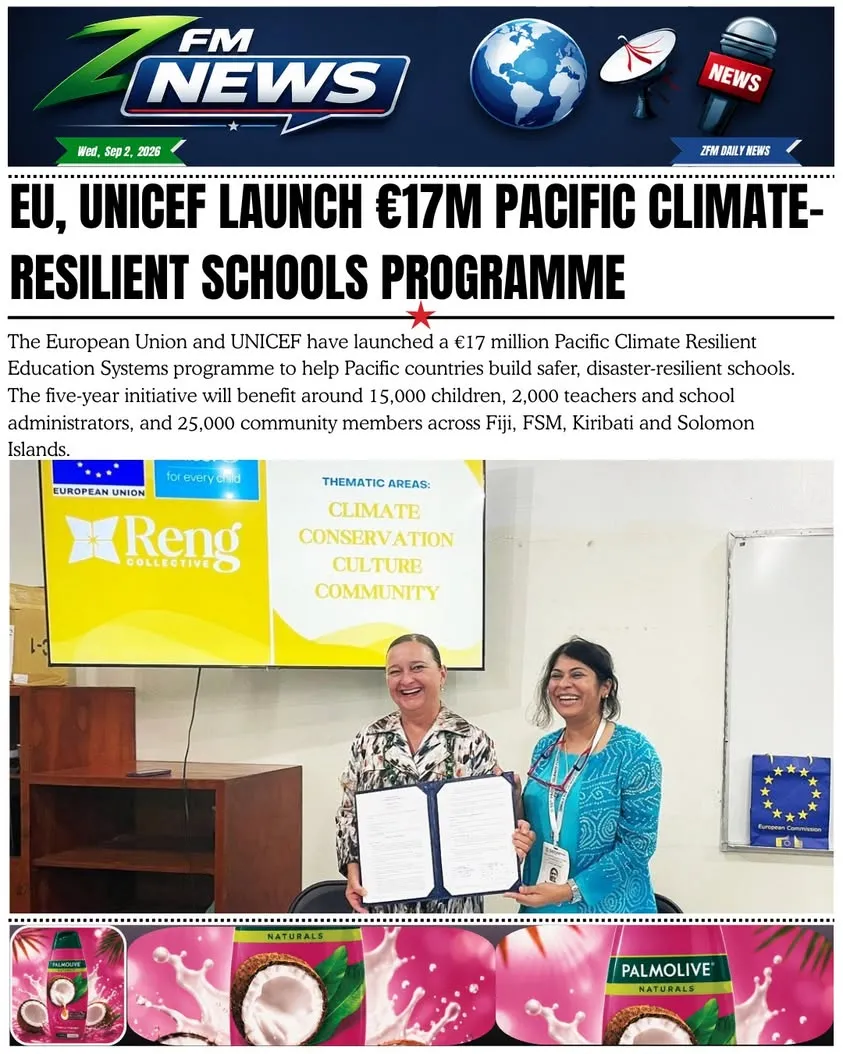
EU and UNICEF Launch €17 Million Pacific Climate-Resilient Education Programme
KOROR, PALAU – 2 September 2026: The European Union and UNICEF have launched a €17 million programme aimed at helping Pacific countries build safer and more climate-resilient schools.
The Pacific Climate Resilient Education Systems (Pacific CRES) programme was signed and launched during a side event of the 55th Pacific Islands Forum Leaders Meeting in Palau.
The five-year initiative will support Fiji, the Federated States of Micronesia, Kiribati and Solomon Islands in strengthening school infrastructure and preparing education systems for climate-related disasters.
Across the Pacific, cyclones, floods and rising sea levels continue to damage classrooms, water systems and other school facilities, particularly in remote communities.
The programme will upgrade existing school infrastructure, strengthen maintenance systems and introduce practical measures to help schools remain operational during and after disasters.
Planned improvements include climate-resilient water and sanitation facilities, renewable energy systems and improved connectivity.
The initiative will also help governments plan and budget for the long-term maintenance of school facilities, reducing the cycle of repeated damage and reconstruction following disasters.
UNICEF Pacific Deputy Representative Roshni Basu said the programme would focus on long-term solutions to protect children's education from growing climate and disaster risks.
Over the next five years, Pacific CRES is expected to directly benefit around 15,000 children through improved school facilities.
It will also provide training for approximately 2,000 teachers and school administrators on disaster preparedness and school resilience, while engaging around 25,000 community members in disaster risk reduction and school maintenance activities.
The programme will be implemented by Ministries of Education in partnership with UNICEF, National Disaster Management Offices, climate change authorities and regional organisations across the four participating countries.
[ENDS]///
By Lesley Foinagwa
Foubaba Community High School in West Kwaio, Malaita Province has marked a major milestone with the official handover of its new School Assembly Hall, delivered through the Australia–Solomon Islands Partnership and facilitated by the West Kwaio Constituency.
The ceremony on Monday, 31 August 2026 brought together community leaders, parents, church representatives, teachers, students and the wider Foubaba community, highlighting strong local ownership and collective pride in the new development.
Second Secretary of DFAT, Bridgette Cottrill , attended on behalf of the Australian Government and congratulated the community, emphasising that the project reflected the power of working together to strengthen education services. “We are together to build our school, Foubaba. Congratulations to everyone,” she said.
The new Assembly Hall will serve as a central space for school assemblies, learning activities, community gatherings and important events providing a safer, more functional environment for students and teachers.
School Principal Dudley Su’akeu expressed deep appreciation to the Australian Government, the Solomon Islands Government and the West Kwaio Constituency for enabling the project. He said the handover marked a significant achievement for the school and a long‐term investment in the wellbeing of students and the community.
The project is part of the ongoing Australia–Solomon Islands partnership supporting community development and improved education infrastructure across Malaita Province. For Foubaba Community High School, the completion of the Assembly Hall represents progress, unity and a stronger future for generations of learners.
BY BEN BILUA
Jejevo
THE proposed establishment of a Western Region has emerged as one of the key issues before the 18th Synod of the Diocese of Ysabel (DOY).
The proposal is among 10 motions tabled for debate during day four of the Synod currently underway in Jejevo.
The proposed Western Region is intended to address administrative and logistical challenges faced by the Diocese in serving its communities in the Western and Choiseul provinces.
If adopted, the proposal would introduce a new administrative structure aimed at improving the Diocese’s reach and delivery of ministry services to communities in the two provinces.
Other motions before the Synod include a proposal for St Peter at Noro Base to become a stand-alone parish and a call for St Luke Gizo Parish to develop DOY land.
Members will also debate issues relating to gambling and lottery in the Diocese, as well as a motion calling for holiness and faithful leadership among church leaders.
Another proposal seeks to establish a partnership between DOY and Chinese investors in retail business, while a separate motion calls for land to be allocated to the Diocese by the Isabel Provincial Government.
The Synod will also consider the establishment of Jejevo Community High School under the Anglican Church of Melanesia Education Authority.
Other motions address the resettlement of clergy, officiating church services where liquor is consumed, and a proposal for parishes to raise funds towards the Cathedral.
The 10 motions will be presented and debated by Synod members before being put to a vote.
Motions receiving the support of members will be adopted and incorporated into the final resolutions of the 18th Synod.
The outcomes are expected to shape the Diocese’s administration, ministry and development priorities in the years ahead.
For feedback, contact: maetuana777@gmail.com
Editor: irwin2angiki@gmail.com
BY BEN BILUA
Jejevo
THE Diocese of Ysabel (DOY) 18th Synod has passed five motions following deliberations during its third-day session yesterday.
The motions were presented on the floor of the Synod, debated by members and subsequently put to a vote before being vetted and approved by Synod Chairperson Bishop Christopher Hope Fihu.
The five motions passed are the Strategic Plan of the Diocese of Ysabel, Strategic Plan Draft Committee 2026, establishment of a Reconciliation Office, re-appointment of the Diocesan Cathedral Committee 2026, and recruitment of an Education Secretary.
The motions will now form part of the Synod resolutions and will be further deliberated and incorporated into the Diocese’s three-year strategic plan.
Bishop Fihu acknowledged the movers of the motions and Synod members who contributed to the discussions and debates before the motions were passed.
He encouraged clergy and Synod members to critically discuss issues affecting the Church, saying constructive debate is important in identifying practical solutions.
Bishop Fihu said open and critical discussions would enable the Diocese to address its challenges and strengthen its ministry and programmes.
The passage of the five motions is expected to provide direction for several areas of the Diocese’s work as it develops and implements its priorities over the next three years.
Other motions will be tabled today as the Synod continues.
For feedback, contact: maetuana777@gmail.com
Editor: irwin2angiki@gmail.com
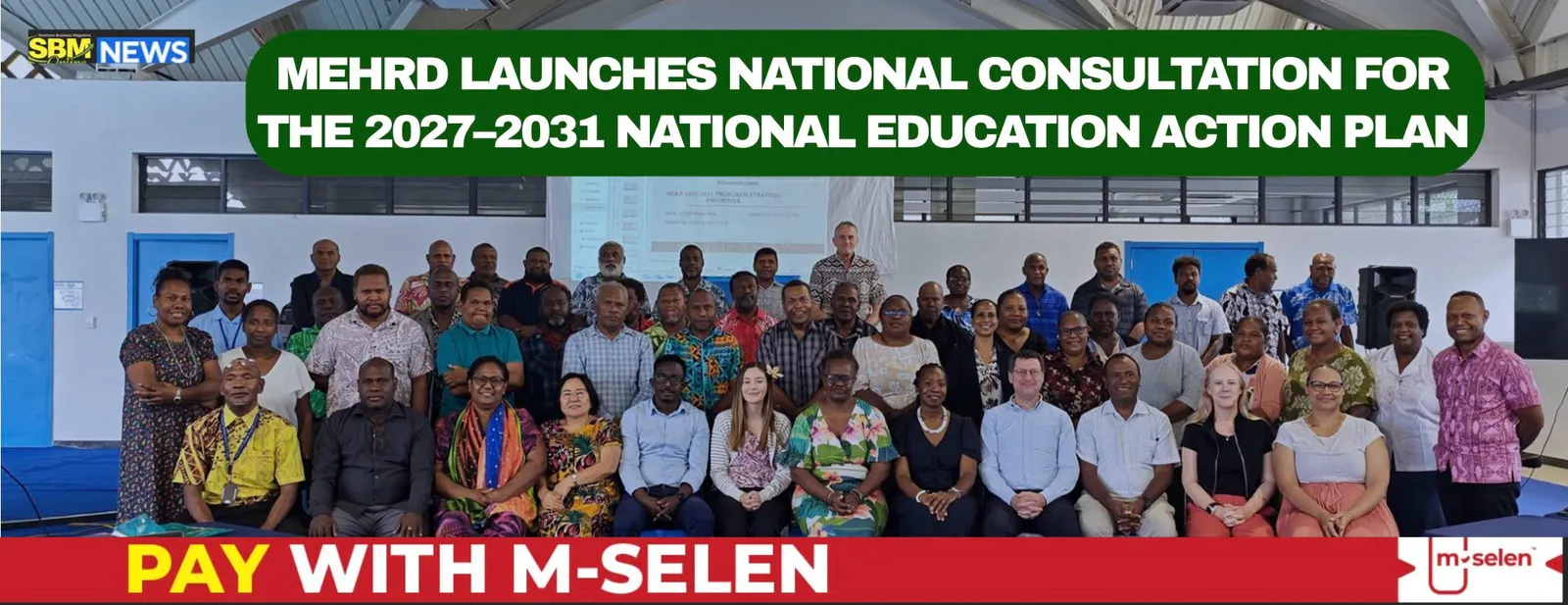
MEHRD LAUNCHES NATIONAL CONSULTATION FOR THE 2027–2031 NATIONAL EDUCATION ACTION PLAN
The Ministry of Education and Human Resources Development (MEHRD) today officially launched the national consultation for the development of the National Education Action Plan (NEAP) 2027–2031 at the National Aquatic Centre in Honiara.
The two-day consultation, held from 1–2 September 2026, brings together provincial governments, education providers, school leaders, teachers, student representatives, youth and women, development partners, faith-based organisations, non-government organisations, civil society organisations, MEHRD officials and representatives of the Solomon Islands Government.
The NEAP 2027–2031 will serve as the education sector’s principal five-year implementation plan. It is grounded in a planning framework that links Sustainable Development Goal 4, the Pacific Regional Education Framework, the Solomon Islands National Development Strategy, the Education Strategic Framework 2015–2030, successive National Education Action Plans and MEHRD annual work plans.
Delivering the official opening statement, MEHRD Supervising Permanent Secretary Mrs Linda Wate said the new NEAP must not be viewed simply as a Ministry document, but as a national education plan belonging to all Solomon Islanders.
She said the plan must reflect the experiences, aspirations, challenges and priorities of the provinces, schools, teachers, learners, families and communities. “We cannot shape the future of education from Honiara alone,” Mrs Wate said.
Mrs Wate encouraged participants to examine honestly the achievements and challenges of the current NEAP 2022–2026 and determine what the education sector should continue, stop or begin doing differently. She stressed that learners must remain at the centre of every discussion and decision.
She also emphasised that inclusion must meaningfully address the needs of children in remote and rural communities, learners with disabilities and additional learning needs, girls and boys, young people at risk of dropping out, and others who experience barriers to quality education.
Provincial ownership, she said, would be essential because education challenges and service-delivery conditions vary significantly between urban centres and remote island communities. The new plan must therefore provide clear national direction while remaining responsive to provincial and local realities.
Mrs Wate called for a practical plan that clearly identifies intended outcomes, responsibilities, resources, timelines and measures of progress. She also urged government, development partners and communities to work towards one national education agenda, one set of priorities and coordinated implementation.
Mr Benjamin Grubb, Head of Office, UNICEF Solomon Islands, addressed the launch and reaffirmed UNICEF’s support for an inclusive, equitable and evidence-informed national education plan centred on the needs, rights and wellbeing of every child.
Ms Sammy O’Hara, Second Secretary, New Zealand High Commission, also addressed participants and reaffirmed New Zealand’s continuing partnership with the Solomon Islands Government and its support for national education priorities.
Consultation to validate and prioritise strategies
During the consultation, participants will consider a consolidated analysis of the education sector, including achievements, continuing challenges and recommendations for improvement. They will review proposed strategic priorities using a “Start–Stop–Continue” approach to identify effective strategies that should continue, approaches that should stop or be revised, missing interventions and priority actions for implementation from 2027.
Participants will also hear the perspectives of students and parents and work towards consensus on the key recommendations to be incorporated into the final NEAP 2027–2031.
The consultation represents an important opportunity for education stakeholders to collectively shape a practical, achievable and inclusive plan that improves learning and supports the wellbeing of every learner in Solomon Islands.
The workshop will conclude on Wednesday, 2 September 2026.
Chottu takes Solomon Islands voice to Melbourne sports roundtable
BY RICHARD MENANOPO
SOLOMON Islands Chess Federation (SICF) president Simon Chottu is in Melbourne, Australia, taking part in a regional roundtable focused on innovation, digital transformation and sustainable development in sport.
The two-day programme, organised by WhiteBIT Australia, brings together chess leaders and representatives from across Oceania, including Australia, Papua New Guinea, Fiji, Vanuatu, Kiribati and Solomon Islands.
The discussions are looking at how technology and innovation can strengthen sporting organisations, improve access to opportunities across the Pacific and develop more sustainable funding models.
For SICF, the programme also provides an opportunity to explore ways of expanding chess in schools and creating more opportunities for young players in Solomon Islands.
SICF President Simon Chottu joins fellow Oceania sports representatives during the Melbourne Roundtable programme.
Chottu said the gathering was important for smaller Pacific sporting federations to build partnerships and ensure that their voices are included in discussions about the future of sport.
“For Solomon Islands, this is about creating opportunities. Technology can help overcome the challenges of distance and limited resources, while partnerships can help us provide more competitions, training and development opportunities for our young people,” he said.
As part of the programme, Chottu will also visit a school chess tournament at Camberwell Boys Grammar School.
The visit will allow him to observe the development of school chess in Australia and engage with organisers and participants.
Participants engage in discussions during the Melbourne Roundtable on innovation and sustainable development in sport.
SICF said chess in schools remains an important part of its long-term development programme and hopes the Melbourne visit will provide lessons that can support the expansion of the sport among schools and young people in Solomon Islands.
The visit is also expected to strengthen relationships among Oceania chess federations and open discussions on possible cooperation in youth development, technology, sponsorship, competitions and regional chess programmes.
SICF said the Melbourne engagement forms part of its broader efforts to grow chess and create more opportunities for Solomon Islands players.
For feedback, contact: mnorichard4@gmail.com
Editor: irwin2angiki@gmail.com