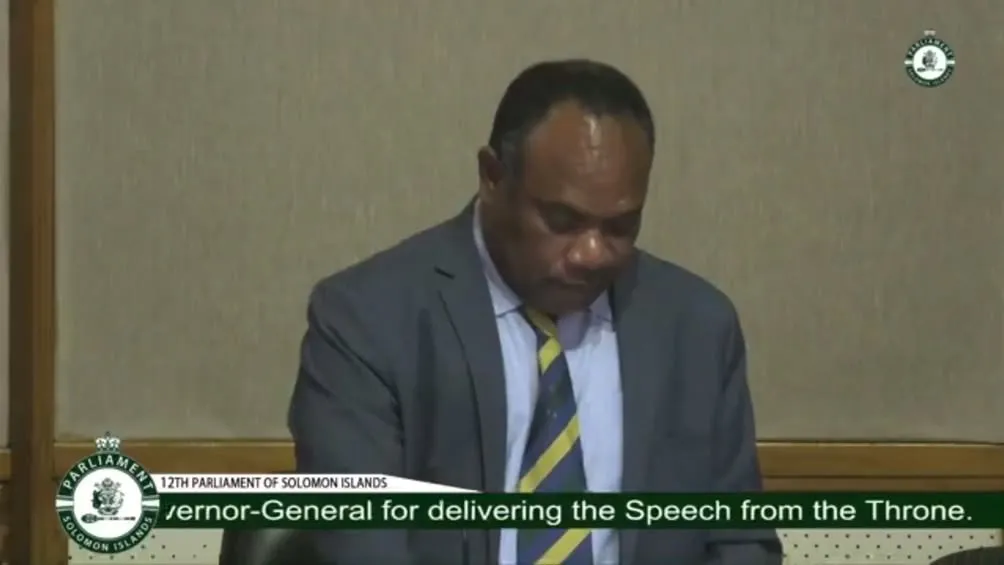
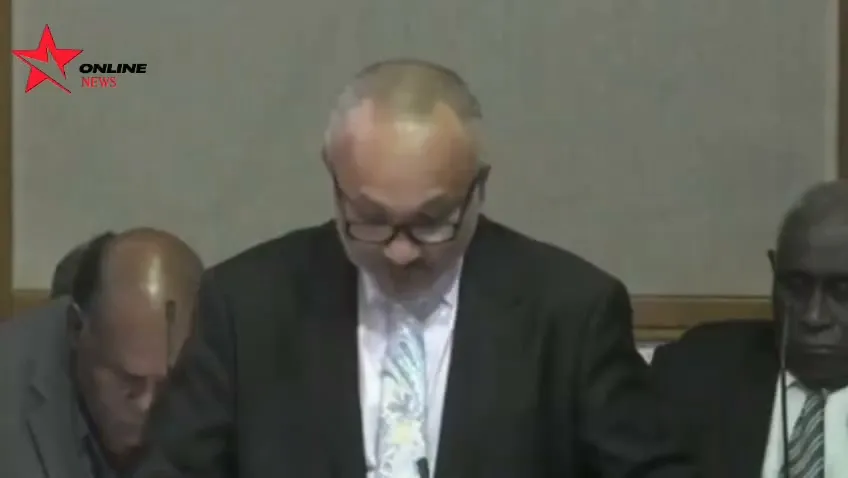
By Georgina Maka’a Opposition Leader Manasseh Sogavare has launched a scathing attack on the Government’s proposed Fee-Free Education policy, saying...
The post Sogavare Slams “Undefined” Fee-Free Education Promise: “This House Cannot Vote on a Slogan” appeared first on In-depth Solomons .
EDUCATION REFORM FACES KEY CHALLENGES: KUMI | Education Minister Hon. Stephen Kumi says the Solomon Islands has made good progress in education, but important challenges still need to be addressed. Speaking in Parliament during his response to the Speech from the Throne, Minister Kumi highlighted issues including maintaining free education, building more classrooms, providing learning materials, improving teacher quality, strengthening education management, expanding digital services, and improving access for rural and remote schools. He said education reforms will require strong cooperation between the national government, Parliament, provincial governments, churches, schools, communities, and development partners. Minister Kumi thanked donor partners and education stakeholders for their continued support, saying their contributions have helped improve schools, increase access to education, and create better opportunities for students across the Solomon Islands. He expressed hope that these partnerships will continue as the country works to build a stronger and more effective education system.
Visual credit @ NPSI Media
教育改革面临关键挑战:库米 | 教育部长斯蒂芬·库米(Hon. Stephen Kumi)表示,所罗门群岛在教育方面取得了良好进展,但仍需解决重要挑战。在国会回应王座演讲时,库米部长强调了包括维持免费教育、建设更多教室、提供学习材料、提高教师质量、加强教育管理、扩展数字服务以及改善偏远学校的可及性等问题。他表示,教育改革将需要国家政府、国会、省级政府、教会、学校、社区和发展伙伴之间的强有力合作。库米部长感谢捐助伙伴和教育利益相关者的持续支持,称他们的贡献帮助改善了学校,增加了教育的可及性,并为所罗门群岛的学生创造了更好的机会。他希望这些伙伴关系能够继续,因为国家致力于建立一个更强大和更有效的教育系统。
视觉来源 @ NPSI Media
Buruku Adventist CHS loses $9,000 in a break-in, forcing a week-long class suspension as police investigate UGHELE, Rendova – Buruku Adventist Community High School in Ughele Village, Western Province, has suspended classes for one week after thieves allegedly broke into the school’s administration office and stole approximately $9,000 in cash. The break-in reportedly occurred at [...]
The post $9,000 Reportedly Stolen During Break-in at Buruku Adventist Community High School appeared first on Tavuli News (Solomon Islands) .
By RODRICK DESURI
Auki
Malaita Premier Elijah Asilaua has signed a Memorandum of Understanding (MoU) with the World Evangelism Alliance (WEA) in South Korea.
The MoU opens the way for stronger international partnerships and new development opportunities for the province.
The agreement was signed in South Korea following an invitation from WEA.
A source close to the matter, speaking to Island Sun from Korea said the signing took place last night.
“The signing of the agreement is about to start. About 9PM, after signing we will get you a group photo.
“The MoU is expected to strengthen cooperation between Malaita Province and the South Korea-based Christian organisation in areas including education, youth development, leadership training, community development, church partnerships and international engagement,” the source said.
The partnership is also expected to connect Malaita with wider regional and global church networks, creating opportunities for exchanges, training programmes and institutional cooperation.
The agreement supports WEA’s broader expansion into the Pacific, aimed at uniting evangelical churches, strengthening regional missionary partnerships and advancing its global initiative “The Gospel for Everyone by 2033”.
WEA is a South Korea-based Christian organisation involved in global outreach, student training and international educational partnerships.
It is understood WEA had signed memorandums of Understanding with Gwaigeo Community High School and Aligegeo Secondary School in May this year, signalling growing engagement between the organisation and educational institutions in Malaita.
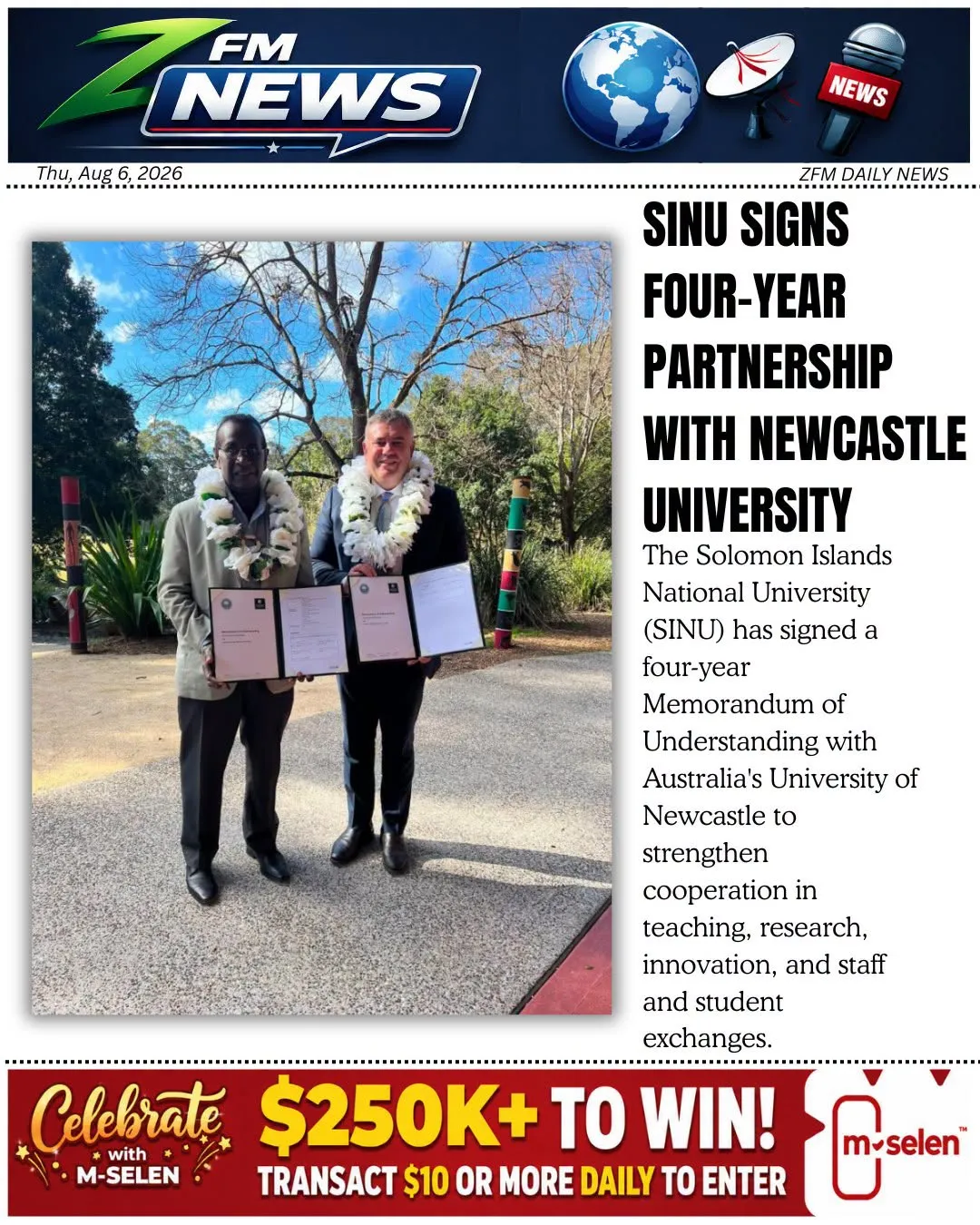
SINU Signs Four-Year Partnership Agreement with University of Newcastle
The Solomon Islands National University (SINU) has strengthened its international partnerships by signing a four-year Memorandum of Understanding (MoU) with the University of Newcastle, Australia, aimed at expanding collaboration in teaching, research, innovation, and institutional development.
The agreement was signed during an official visit by SINU Vice-Chancellor Professor Transform Aqorau to the University of Newcastle from 30 to 31 July 2026.
Professor Aqorau signed the MoU on behalf of SINU, while Mr Nathan Towney, Interim Deputy Vice-Chancellor (Engagement and Equity), signed on behalf of the University of Newcastle.
The partnership establishes a framework for cooperation in teaching, research, staff and student mobility, innovation, and institutional development, supporting the sustainable development priorities of Solomon Islands.
Professor Aqorau described the agreement as a significant milestone in SINU's internationalisation journey, saying it aligns with the University's Strategic Plan 2026–2030 by strengthening academic quality, expanding research opportunities, enhancing postgraduate education, and building staff capability through international collaboration.
During the visit, representatives from both institutions identified several priority areas for collaboration. These include programme quality and accreditation, public health, fisheries and marine governance, engineering, renewable energy, digital education, Indigenous and Pacific knowledge systems, and environmental sustainability.
The two universities also discussed developing a Graduate Certificate in Recycling and Waste Management to help build national expertise in environmental management and support the transition towards a circular economy.
SINU said it looks forward to working closely with the University of Newcastle to implement the partnership and deliver meaningful outcomes that strengthen higher education, research, and national development in Solomon Islands and across the Pacific.
ENDS////////////////
BY DOUGLAS VAHIA
The British High Commission in Honiara in partnership with the National Art Gallery is launching a new exhibition in Honiara which will display some of the world’s finest nature photographs.
The world-renowned exhibition is on loan from the Natural History Museum in London and opens at the Solomon Islands National Art Gallery this week.
On Wednesday, the Permanent Secretary of the Ministry of Tourism and British High Commissioner, along with other diplomats, got a sneak preview of the exhibition which contains some of the most exceptional nature photographs taken today from across the globe.
Local schools and youth groups will be visiting to exhibition in the coming days.
The exhibition shines a light on powerful and fascinating images that capture hidden animal behaviour, spectacular species and the breathtaking diversity of the natural world. Using photography’s unique power to engage and inspire audiences, the images share stories and species from around the world, encouraging a future advocacy for the planet.
At the pre-launch event on Wednesday, British High Commissioner, HE Paul Turner underlined not only the prestigious nature of the exhibition but also how important it is in highlighting the environmental challenges we face today.
He said each photograph contains a story, showing the link between wildlife and habitat and man. Turner said that the exhibition conveys a message of beauty but also fragility with a clear message about the need to safeguard our planet’s biodiversity.
Permanent Secretary of Ministry of Tourism, Bunyan Sivoro, thanked the British High Commission for arranging for the exhibition to come to Honiara. He said it is encouraging that so many local schools will be visiting the exhibition as this will engage young people to preserve their local environment.
The UK Wildlife Photographer of the Year is the most famous photography event of its kind.
Launched in 1965, the competition today receives entries from all over the world, highlighting its enduring appeal. Last year’s award-winning images have embarked on an international tour that allowed them to be seen by well over a million people. This year’s competition attracted over 60,000 entries last year from photographers of all ages. A selection is shown in the exhibition in Honiara.
Dr Doug Gurr, Director of the Natural History Museum in London said: “We are thrilled to continue Wildlife Photographer of the Year as a powerful platform for visual storytelling, showing the diversity, beauty and complexity of the natural world and humanity’s relationship to it. This year’s exhibition will be our best combination of great artistry and groundbreaking science yet, helping visitors to become inspired to be advocates for our planet.”
The exhibition will be at the National Art Gallery through August.
Photo: Supplied
For feedback, contact: diivee56@gmail.com
Editor: irwin3angiki@gmail.com
BY CHARLES STENNETT
The National Parliament of Solomon Islands (NPSI) through its Public Engagement and Communication Department, conducted a civic awareness outreach programme for students and teachers of Nguvia Community High School last week.
A statement from NPSI media said the outreach programme was facilitated by officers from the Department’s Civic Education Unit.
The officers delivered presentations on the role and functions of Parliament, the law-making process, the oversight responsibilities of parliamentary committees, and the important role citizens play in a representative democracy.
Students were encouraged to develop a greater understanding of Parliament as the supreme law-making institution of the country and to appreciate the importance of civic responsibility, active citizenship and informed participation in democratic governance.
The statement said the interactive session also provided students with the opportunity to engage directly with parliamentary officers through a question-and-answer session, hence, allowed them to deepen their understanding of parliamentary procedures, the responsibilities of members of Parliament, and the work undertaken by the National Parliament.
The outreach forms part of the National Parliament’s ongoing civic education programme, which seeks to increase public understanding of Parliament and strengthen engagement with schools, communities, and other stakeholders throughout Solomon Islands.
The National Parliament remains committed to fostering an informed and engaged citizenry by providing accessible civic education programmes that encourage greater public participation in the country’s democratic processes.
For feedback, contact: charsstennett@gmail.com
Editor: irwin3angiki@gmail.com
Isabel Hosts First Mission for $28.7m School Meals Project
By ULUTAH GINA
Solomon Star, Honiara
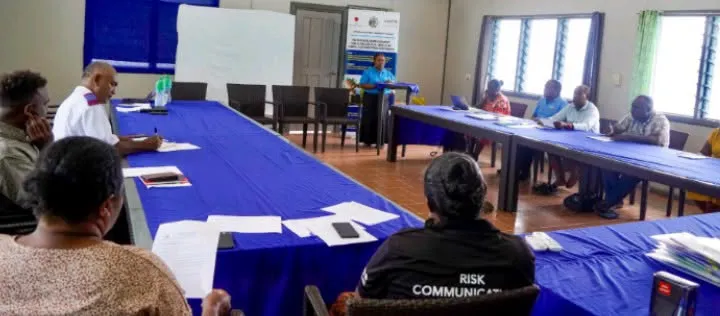
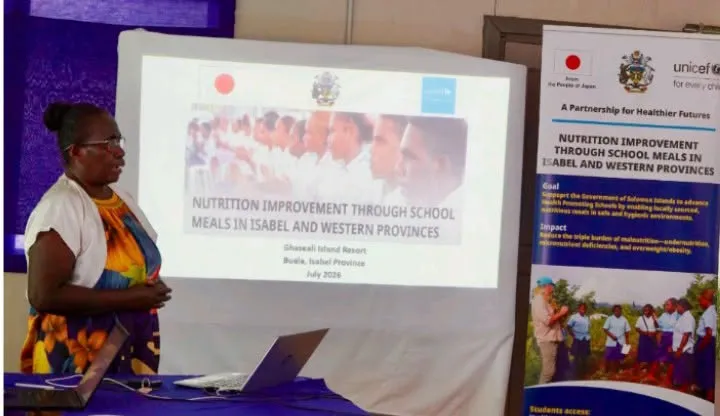
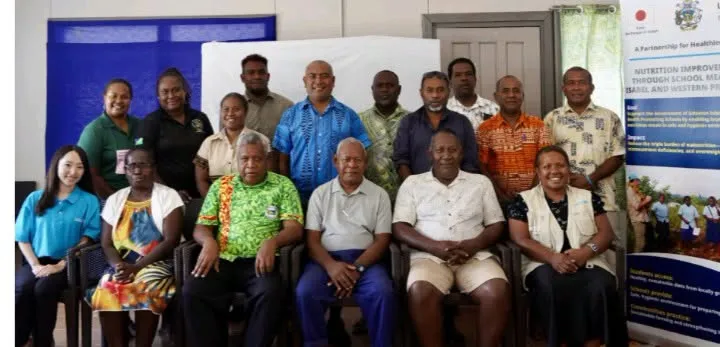
Isabel Province has become the first province to host an implementation planning and monitoring mission for a US$3.4 million (approximately SBD28.7 million) Nutrition Improvement through School Meals Project, which will benefit boarding schools in both Isabel and Western provinces.
The mission, held in Buala last month brought together representatives of the Solomon Islands Government, UNICEF, the Government of Japan and the Isabel Provincial Government to prepare for the rollout of the project and strengthen provincial ownership ahead of implementation.
Funded by the Government of Japan, the project is being implemented by UNICEF in partnership with the Ministries of Education and Human Resources Development, Health and Medical Services, Agriculture and Livestock, and the Isabel and Western Provincial Governments.
The project covers nine boarding schools, three in Isabel Province and six in Western Province and aims to improve children's nutrition, strengthen school food systems, support local farmers and promote sustainable school meal programmes using locally produced food.
During the courtesy meeting, provincial leaders and government officials were updated on progress across the project's key areas, including strengthening school farms, improving links between schools and surrounding farming communities, upgrading kitchens and food storage facilities, improving water, sanitation and hygiene (WASH) infrastructure, and developing a National School Meals Strategy to guide future expansion.
Officials were told that the project adopts a multi-sector approach by integrating nutrition, agriculture, education, health, food safety and school infrastructure to improve the health and wellbeing of students while strengthening local food systems.
UNICEF informed the meeting that preparations are already underway, with an agriculture adviser recruited to support implementation and ADRA selected as the implementing partner to establish and strengthen school farms and community agriculture activities.
The Ministry of Agriculture and Livestock will provide technical coordination, supervision and monitoring during implementation.
The meeting also heard that procurement of agricultural machinery and farming equipment is progressing.
Planned support includes a tractor for Muana Community High School, additional agricultural implements for the existing tractor at Sir Dudley Tuti College, and a power tiller and farming tools for Allardyce Provincial Secondary School.
The equipment is being provided based on needs assessments conducted at each participating school.
To improve the quality of school meals, the project will also develop menu planning guides, food safety standards and locally appropriate recipes using foods available within participating communities.
A nutrition consultant has been engaged to assess local dietary practices and food availability to support the development of nutritious school menus.
Kitchen assessments have already been completed at participating schools, with new kitchen designs prepared and procurement and construction processes now progressing.
Teachers, cooks and other school staff will also receive training in food preparation, food safety, nutrition, hygiene and the proper use of school facilities.
Speaking during the meeting, Isabel Provincial Secretary John Mark Lokumana welcomed the delegation and reaffirmed the provincial government's commitment to the programme.
"Isabel is fortunate to have three of our secondary boarding schools selected under this project.
"As we move from planning into implementation, it will take the education, health and agriculture sectors working together to make this a success, and our provincial government stands ready to support that work," Mr Lokumana said.
Provincial Minister for Education Augustine Hebala thanked the Government of Japan and UNICEF for including Isabel in the project and urged the implementation team to move forward with planned activities.
"We are pleased this project is being implemented in our province, and we encourage the team to proceed with the work ahead.
"Our schools need visible improvements, particularly to water and sanitation facilities, and we want to see this support translated into real change for our students," Mr Hebala said.
The meeting also discussed the long-term sustainability of school farms and school meal systems, including how responsibilities will be shared at the school level and how agriculture, nutrition and hygiene education can be integrated into classroom learning.
Officials further noted that the National School Meals Strategy under development will provide a long-term framework and costed implementation plan to expand school meals programmes to more schools and provinces across Solomon Islands.
UNICEF reaffirmed its commitment to working with the Solomon Islands Government, provincial governments, schools and communities as the project moves from planning to implementation, describing the initiative as an investment in healthier learners, stronger local food systems and more resilient communities.
Ends///
PM Wale Declares Nationwide
Fee-Free Education by 2027
By John Chrisma
Solomon Star, Honiara
Prime Minister [PM] Hon. Matthew Cooper Wale has announced that the Government will implement a nationwide fee-free education policy by 2027, describing the initiative as a major investment in the country's future workforce.
Speaking during the debate on the 'Traditional Speech from the Throne' in Parliament, Wednesday, Prime Minister Wale said the policy aims to remove the financial burden that prevents many Solomon Islands families from educating all of their children.
"The free education policy will be implemented nationwide by 2027," Prime Minister Wale said.
He stressed that the policy did not originate with the current Government.
"The case for free education was made in this House many years before, first under the Sikua-led Government.
“We all know, Mr. Speaker, the burden our parents carry. Many must choose which of their children will be educated. That is the injustice this policy seeks to put to an end, Mr. Speaker," he said.
Prime Minister Wale also said the policy is a key part of the Government's long-term economic vision.
"I have said in this House before that free education is key to producing the highly skilled workforce our economy will need over the next 30 years as we move towards processing and manufacturing. That is the economy we must build," he said.
Meanwhile, Opposition Leader Hon. Manasseh Sogavare raised several questions regarding how the policy will be implemented.
"What does fee-free education mean? Does it apply only to schools owned and administered by the Solomon Islands Government and provincial governments?
"Or does it extend to church-run schools and other authorised education providers?
"Does it cover tuition fees only, or does it also cover boarding fees, food, dormitory costs, uniforms and transport?" Mr. Sogavare asked.
He referred to the Education Act 2023 and the Education Regulations 2024, saying they already make a careful distinction between government-funded schools and self-funded schools.
Mr. Sogavare also cited the current government subsidy rates, noting that the existing support includes 800 per year for a non-urban secondary day student.
The debate on the Government's proposed fee-free education policy is expected to continue as Members of Parliament [MP] examine its scope, funding arrangements and implementation ahead of its planned nationwide roll-out in 2027.
BY TONY IROGA
Deputy Prime Minister, Francis Sade has reaffirmed the Government’s commitment to advance constitutional reform towards a federal system, while cautioning that no fixed timeline can be promised for Guadalcanal’s long-standing aspiration for statehood.
Speaking at the 42nd Guadalcanal Second Appointed Day celebration at the National Stadium in Honiara on Monday, Mr. Sade acknowledged the province’s historical pursuit of federalism.
“Your aspiration for a federal system of government does not go unheard. I, of all people, cannot pretend not to hear because, as your former Premier, I once voiced the same aspiration from the very platform you spoke from today,” Mr. Sade said.
He said the Government remains committed to pursue constitutional reform through lawful and bipartisan processes, supported by research and evidence.
“What I can promise, in good faith, is real momentum, transparency and a government that will carry this process forward through frank and fair discussion within the Constitution,” he said.
Mr. Sade, however, ruled out committing to a specific date for statehood.
“I will not stand before the people of Guadalcanal and promise a date that does not lie within my gift. Promises lightly made and later broken have wounded this relationship before,” he said.
He said the ongoing cost-benefit analysis across all provinces will provide an evidence-based foundation for any constitutional decisions and welcomed Guadalcanal Province’s readiness report for statehood which will be submitted to the Constitutional Reform Unit.
On provincial governance, Mr. Sade said the Government is strengthening provinces by improving their ability to draft laws and policies.
He revealed that the Ministry of Provincial Government and Institutional Strengthening (MPGIS) has recruited four legal consultants with funding from UNICEF to assist all nine provinces to prepare policies and draft ordinances.
“This is empowerment in its most practical legal form, giving provinces the tools to make their own laws well,” he said.
Mr. Sade also confirmed that the Ministry has received Guadalcanal Province’s proposal for a new provincial headquarter and will prepare a submission for funding consideration under the 2027 budget.
He said the proposed $8 million investment will be a strategic investment that aims to improve governance, service delivery, business growth, employment and urban development along the Mamara Corridor.
Addressing development priorities, Mr. Sade said the National Government has taken note of Guadalcanal’s requests for a provincial hospital and road infrastructure.
“The National Government hears both requests clearly. Both speak to equity, and we will pursue these priorities through national planning and budgeting processes together with our development partners,” he said.
On the country’s mineral resources, Mr. Sade said the Government intends to ensure greater national ownership of the mining sector through the establishment of a state-owned mining enterprise, a mineral holding company and a gold trading scheme under the Central Bank.
“Minerals without justice do not enrich a people; they embitter them. Fair compensation for landowners and genuine national participation are preconditions for peace, development and dignity,” he said.
He also announced that legislation to establish a Sovereign Wealth Fund will be introduced in Parliament next year, describing it as an investment for future generations.
“Natural resources are temporary. The wellbeing of future generations must not be. The revenues of today should become opportunities for tomorrow,” he said.
He concluded by acknowledging the Government’s recent decision to clear more than $10 million in outstanding payments owed to Solomon Islands National University (SINU) to allow students to receive their certificates and continue their careers.
For feedback, contact: tonyiroga8@gmail.com
Editor: irwin3angiki@gmail.com
JICA SOLOMON ISLANDS WELCOMES THREE NEW VOLUNTEERS
By FLOYD TERRY JNR
Solomon Star, Honiara
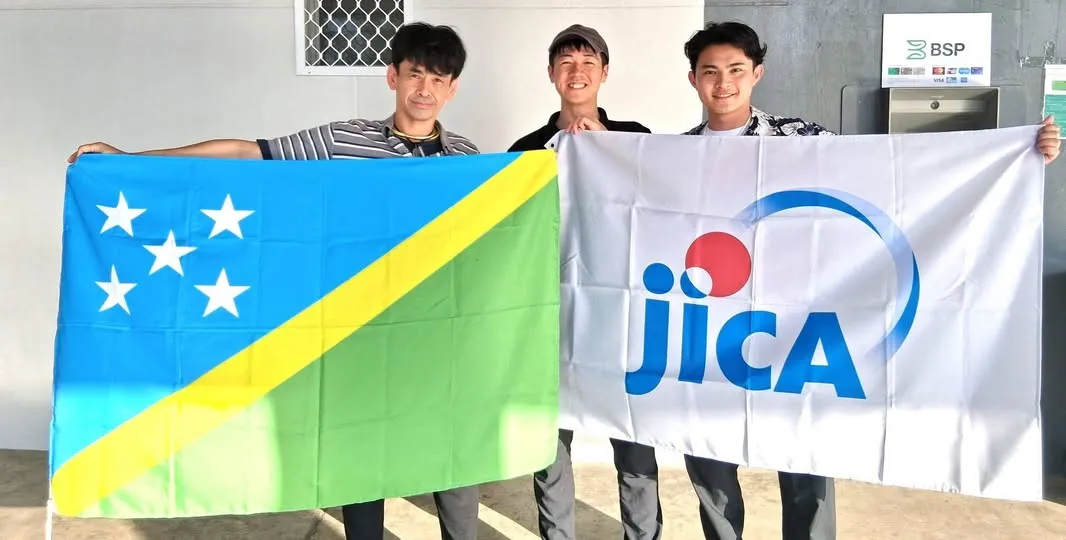
The Japan International Cooperation Agency (JICA) Solomon Islands has welcomed three new volunteers who will begin assignments supporting community development and education in the country.
JICA Solomon Islands said the volunteers arrived on July 29, 2026, and will be based in Malaita, Western Province and Honiara.
The new volunteers are; Mr. Fujita Tomoki, Mr. Shinozaki Kai and Mr. Tanaka Shin.
Mr. Fujita Tomoki will be based in Auki, Malaita Province, where he will work with the Fisheries Department in the field of community development.
His assignment will focus on working closely with local communities and the Fisheries Department to support community-based development initiatives and contribute to sustainable livelihoods.
Mr. Shinozaki Kai will be stationed in Gizo, Western Province, also working with the Fisheries Department in community development.
He will collaborate with the department and local communities to strengthen community development activities and support sustainable fisheries-related initiatives.
Meanwhile, Mr. Tanaka Shin will serve at St. Nicholas Primary School as a Physical Education teacher.
His work will involve supporting students through sports and physical activities, while promoting healthy lifestyles and quality education.
JICA Solomon Islands said it was delighted to welcome the three volunteers and looked forward to the positive contribution they would make within their respective host organisations and communities.
The agency also wished the volunteers a successful, rewarding and memorable experience during their service in Solomon Islands.
BY RICHARD MENANOPO
The Royal Solomon Islands Police Force (RSIPF) has issued a public safety warning ahead of a planned unexploded ordnance (UXO) disposal operation at Hells Point in the Alligator Creek area tomorrow from 8am to 1pm.
The Explosive Ordnance Disposal Department (EODD) will carry out a controlled demolition of explosive remnants of war at the Hells Point Demolition Range in Central Guadalcanal between 8am and 1pm tomorrow, a police statement today said.
The operation will require members of the public, particularly farmers, fishermen, hunters and residents living around Henderson, Alligator Creek and Tenaru School, to stay clear of the demolition area while the exercise is underway.
“Farmers, fishermen, hunters and members of the general public in and around the Henderson area, Alligator Creek and Tenaru School are kindly advised to keep away from the Hells Point demolition range while the operation is in progress,” Director of EOD Inspector Clifford Tunuki said.
He said controlled evacuations and temporary roadblocks would also be enforced in designated areas between East Henderson and the Tenaru School bus stop to ensure public safety throughout the operation.
Inspector Tunuki explained the demolition forms part of the EOD Department’s weekly operational programme to safely dispose of unexploded ordnance and reduce the quantity of explosive materials currently stored at the site.
“The Air Traffic Control Tower at Honiara International Airport will coordinate the firing of each demolition serial. EOD operators will also be posted at the control tower throughout the operation to ensure safe coordination of the demolition activities,” he said.
by Georgina Maka’a Governor General Sir David Kapu says the Government views the health and wellbeing of Solomon Islanders as...
The post Gov’t Promises Better Healthcare And Education For All appeared first on In-depth Solomons .
BY NED GAGAHE
Pacific media organisations are becoming increasingly vulnerable to changes in Facebook’s algorithms, with publishers warning that unexplained declines in audience reach are threatening access to reliable news and emergency information across the region.
The concerns are raised in Part Two of an analysis by journalist and Pacific Newsroom founder Sue Ahearn, who says many Pacific countries remain heavily dependent on Facebook because of high mobile data costs, unreliable internet coverage and limited access to news websites.
According to the article, Facebook’s parent company, Meta, uses artificial intelligence and various user signals—including likes, comments, shares and previous interactions—to determine what appears in users’ news feeds. However, Ahearn said the company does not disclose how much weight is given to these factors or explain changes to its ranking system, leaving publishers uncertain about why the reach of their stories fluctuates.
Commercial estimates cited in the article indicate Papua New Guinea had about 1.5 million Facebook users in late 2025, highlighting the platform’s importance as a primary source of news and public information for many Pacific Islanders.
Vanuatu Broadcasting and Television Corporation (VBTC) Chief Executive Francis Herman said discussions with media colleagues suggest Facebook may now favour content creators over traditional news publishers, reduce the visibility of posts containing external links and rely more heavily on AI-driven recommendations rather than page followers.
Ahearn said while these observations have not been publicly confirmed by Meta, even small algorithm changes can have a major impact on Pacific media organisations because of their relatively small audiences and limited financial resources.
She said publishers have experimented with strategies such as placing website links in the comments section instead of the main post, but noted there is no evidence that Meta officially recommends such practices. She also questioned suggestions that news organisations should wait long periods between posts, saying such advice is impractical during cyclones, earthquakes, tsunamis or political crises when information must be shared immediately.
The article also highlights Australia’s efforts to address the imbalance between digital platforms and news organisations through the News Media Bargaining Code and a proposed News Bargaining Incentive, which would encourage large technology companies to enter commercial agreements with news publishers.
Ahearn said Pacific countries should closely monitor these developments but ensure any future model reflects the unique circumstances of the region’s smaller news organisations.
She concluded that although Pacific publishers are expanding to other platforms such as WhatsApp and encouraging readers to visit their websites directly, Facebook remains too important to abandon because it continues to be the main gateway to news for many Pacific communities.
“The trap,” she wrote, “is that Pacific publishers depend on Meta to reach their audiences, while Meta can change the way it distributes their work without warning and leave them with little opportunity to appeal its decisions.”
The article first appeared on the Devpolicy Blog, published by the Development Policy Centre at The Australian National University.
JICA welcomes 3 new volunteers to support community development and education
Three new Japan International Cooperation Agency (JICA) volunteers have arrived in Solomon Islands to begin assignments aimed at supporting community development, fisheries and education. The volunteers were officially welcomed by JICA Solomon Islands as they prepare to serve in Malaita, Western Province and Honiara under the agency's volunteer cooperation programme.
Caption: 3 new JICA volunteers. Photo credit - JICA facebook
READ MORE: https://theislandsun.com.sb/jica-welcomes-three-new-volunt.../
BY NED GAGAHE
Three new Japan International Cooperation Agency (JICA) volunteers have arrived in Solomon Islands to begin assignments aimed at supporting community development, fisheries and education.
The volunteers were officially welcomed by JICA Solomon Islands on July 29 as they prepare to serve in Malaita, Western Province and Honiara under the agency’s volunteer cooperation programme.
In a statement shared on its Facebook page JICA said Fujita Tomoki has been posted to Auki in Malaita Province, where he will work with the Fisheries Department in the field of community development. His role will focus on working alongside local communities to strengthen community-based development initiatives and promote sustainable livelihood opportunities.
Another volunteer, Shinozaki Kai, has been assigned to Gizo in Western Province. Also attached to the Fisheries Department, he will support community development activities and assist in promoting sustainable fisheries-related programmes in collaboration with local stakeholders.
Meanwhile, Tanaka Shin has been posted to St. Nicholas Primary School in Honiara as a Physical Education volunteer. He will work with teachers and students to enhance sports and physical education while encouraging healthy lifestyles and quality learning through physical activities.
JICA Solomon Islands said the arrival of the three volunteers reflects the agency’s continued commitment to supporting Solomon Islands through technical cooperation and people-to-people partnerships.
The agency expressed confidence that the volunteers would make meaningful contributions within their host organisations and the communities they will serve.
JICA also thanked the host institutions for their support and welcomed the volunteers to Solomon Islands, wishing them a successful, rewarding and memorable experience throughout their service.
The JICA Volunteer Programme has for many years deployed skilled Japanese volunteers to Solomon Islands, working in sectors such as education, health, agriculture, fisheries and community development to help strengthen local capacity and promote sustainable development.
BY TONY IROGA
Guadalcanal Province yesterday concluded its 42nd Appointed Day celebrations with a colourful ceremony at the National Stadium before festivities continued at FOPA Village.
The province did something no other has done – feed all other provinces. Each constituency on Guadalcanal was assigned to host and feed a province yesterday, making the celebration an inclusive one.
The theme for this year’s celebration was “Empowering Guadalcanal for National Unity and Prosperity”.
The official programme began at 6:30am and featured a guard of honour inspection led by Deputy Prime Minister and Minister for Public Service Francis Sade MP and Guadalcanal Premier Willie Atu.
A curious crowd looks on as the program unfolds, Photo by Tony Iroga
The celebration included a colourful march-past by the Royal Solomon Islands Police Force (RSIPF), Correctional Service of Solomon Islands (CSSI), schools in Honiara, Scouts, Pathfinders and the Police Band, which entertained the large crowd.
Police band entertaining the crowd yesterday at the national stadium, Photo by Tony Iroga
Students of St Joseph Catholic school joined the parade yesterday at the national stadium, Photo by Tony Iroga
Other highlights included the raising of the Guadalcanal Provincial Flag, the cutting of the province’s 42nd Appointed Day cake, and the presentation of traditional Chupu to dignitaries, including the Provincial Minister for Culture and Tourism, provincial premiers, and the Provincial Secretaries.
Deputy Prime Minister receiving a gift and chupu yesterday from a Guadalcanal provincial government representative, Photo by Tony Iroga
Provincial leaders being warmly welcomed by the Guadalcanal government, Photo by Tony Iroga
Malaita leaders received a Chupu gift from Guadalcanal leaders at the program yesterday, Photo by Tony Iroga
Leader of Independent Group Peter Shanel Agovaka receiving a gift and chupu from Guadalcanal provincial government yesterday, Photo by Tony Iroga
Addressing the gathering, Guadalcanal Premier Willie Atu said the celebration’s theme reflects the province’s commitment to work together for development and national progress.
“This year’s theme, ‘Empowering Guadalcanal for National Unity and Prosperity,’ reminds us of the important role Guadalcanal continues to play in building a stronger and more united Solomon Islands,” Mr Atu said.
Guest of honour and Deputy Prime Minister Francis Sade MP congratulated Guadalcanal Province on reaching another milestone and encouraged citizens to continue promoting peace, unity and development.
“The progress of Guadalcanal is vital to the growth and prosperity of our nation. Together we can build a better future for all Solomon Islanders,” Mr Sade said.
Among those attending the official programme were Guadalcanal Diocesan Bishop Benedict Loe, Speaker of the Guadalcanal Provincial Assembly William Barile, Minister for Provincial Government and Institutional Strengthening Alfred Lazarus Rina MP, Guadalcanal Premier Willie Atu, and Deputy Prime Minister Francis Sade MP.
The official programme concluded at 11:30am before celebrations continued with cultural and community activities at FOPA Village.
Photo credit: Tony Iroga
For feedback, contact: tonyiroga8@gmail.com
Editor: irwin3angiki@gmail.com
Premier Atu reiterates Guadalcanal province’s decades-old aspiration
BY TONY IROGA
Guadalcanal Province has renewed its long-standing call for state government status, with Premier Willie Atu declaring that the province’s aspiration for greater autonomy remains strong and unwavering.
“Guadalcanal Province has a strong urge to become the State of Guadalcanal sooner. It is no secret. We have been asking for statehood from outside Honiara.
“Now we are here at your front door and I am knocking again on behalf of the men, women, boys and girls from Guadalcanal Province who are standing behind me, and those in the hills, mountains and villages of Guadalcanal today,” Mr Atu said.
He made the remarks during Guadalcanal Province’s 42nd Second Appointed Day celebration, held for the first time at the National Stadium in Honiara yesterday.
The celebration brought together national leaders, provincial representatives, church leaders, chiefs, government officials and hundreds of Guadalcanal people living in Honiara and throughout the province under the theme, “Empowering Guadalcanal for National Unity and Prosperity”.
He said Guadalcanal’s pursuit of state government is not about division, but about completing the country’s decentralisation agenda by transferring greater administrative, legislative and financial powers to provincial governments.
He reminded the gathering that the province’s demand for greater autonomy dates back decades and acknowledged the difficult history surrounding the Bonafide demands and the ethnic tensions, saying Guadalcanal does not want to revisit that painful chapter.
“That was the dark side of our history that almost brought our national economy to the brink of collapse. We definitely do not want to go down that path again,” he said.
He urges the National Government to work together with Guadalcanal to pursue constitutional reforms that will allow provinces to exercise greater self-governance while maintaining national unity.
The Premier also reflected on the historical significance of the Second Appointed Day, explaining that while provincial governments were established under the Provincial Government Act in 1982, provinces only receive their full development and administrative powers on their respective Second Appointed Days.
Guadalcanal attained its Second Appointed Day on August 1, 1984, making this year’s celebration the province’s 42nd anniversary of full provincial governance.
Atu highlighted a number of achievements under his administration, including improved revenue collection, the establishment of a provincial reserve fund, investment in Central Bank treasury securities, and the province becoming officially debt-free.
He also announced that Guadalcanal Province for the first time in its history, has received a qualified audit opinion from the Auditor-General, describing it as a major milestone in transparency and accountability.
Other achievements include having more than SBD35 million allocated to Provincial Capacity Development Fund (PCDF) projects, investments in roads, bridges, health, education and climate resilience, and the ongoing development of the new provincial headquarters at Mamara.
Atu said relocating the provincial headquarters to Mamara will strengthen governance, improve service delivery and create a new administrative and economic centre for Guadalcanal.
He also reaffirmed the province’s commitment to work with the National Government on major infrastructure projects, including the proposed Aola–Marau road connection.
While celebrating the province’s progress over the past 42 years, the Premier stressed that Guadalcanal’s ultimate aspiration remains the establishment of a state government with greater powers under a federal or devolved governance arrangement.
“The people of Guadalcanal believe empowerment means decentralisation of powers, equitable sharing of national resources and stronger provincial institutions capable of delivering services closer to our people,” he said.
He calls on the National Government to continue advancing constitutional reforms and decentralisation to ensure lasting national unity and sustainable development for all provinces.
For feedback, contact: tonyiroga8@gmail.com
Editor: irwin3angiki@gmail.com
By RODRICK DESURI
Auki
A four-day knowledge-sharing and exchange programme on fish aggregating devices (FADs), fishing methods and seaweed farming was successfully held in Auki, Malaita Province, last week.
The programme was conducted under the Japan International Cooperation Agency (JICA) Knowledge Co-Creation Programme (KCCP), which began in 2025.
The training was organised by JICA in collaboration with the Ministry of Fisheries and Marine Resources and the Malaita Provincial Government.
Anchor and rope preparation. Photo credit – Alick Konamalefo
Senior Fisheries Officer for the Auki Office in Malaita Province, Alick Konamalefo, said nine representatives from nine different overseas countries attended the programme.
He said the programme focused on practical, hands-on learning and the exchange of knowledge and experiences among participants.
“Actually, it was not really a training, but an on-site and hands-on learning and knowledge-exchange programme among the participants,” Mr Konamalefo said.
“It was a session where all participants shared their knowledge and discussed how each country designs its FADs and the methods they use.
“We started on Monday with anchorage and rope preparation, followed by fishing methods on Tuesday, FAD deployment on Wednesday, and site visits on Thursday,” he said.
Konamalefo said the programme provided an opportunity for participants to exchange knowledge and learn about the different ways countries design and deploy FADs, as well as the fishing methods and seaweed-farming practices they use.
Malaita Provincial Fisheries officers also took part in the programme.
BY DOUGLAS VAHIA
A leading Pacific fisheries law expert has dismissed claims that Ship Rider Agreements undermine the sovereignty of Pacific Island nations, saying the arrangements are in fact one of the strongest expressions of national sovereignty.
In an article shared on Facebook, former Forum Fisheries Agency (FFA) legal adviser Dr Transform Aqorau who is the current Vice Chancellor at the Solomon Islands National University (SINU) said misconceptions continue to surround Ship Rider Agreements, with some believing they allow foreign countries to police Pacific waters.
He said that interpretation is incorrect.
“The authority never changes hands. The sovereignty never leaves the coastal State,” Dr Aqorau said.
He explained that under a Ship Rider Agreement, a Pacific Island country places one of its own authorised fisheries officers on a foreign patrol vessel. While the foreign ship provides transport, surveillance capability and logistical support, all legal powers remain with the fisheries officer representing the coastal state.
“The foreign vessel has no independent authority to enforce our fisheries laws. Decisions on boarding, inspection and enforcement remain governed by the coastal state’s own laws,” he said.
Dr Aqorau traced the origins of the agreements to the 1982 United Nations Convention on the Law of the Sea (UNCLOS), which granted Pacific Island countries sovereign rights over Exclusive Economic Zones (EEZs) extending 200 nautical miles from their coastlines.
While the convention gave island nations control over some of the world’s largest ocean territories, he said many lacked the patrol vessels, aircraft, manpower and financial resources needed to effectively monitor and enforce those rights.
Rather than accepting those limitations, Pacific countries responded through regional cooperation under the Forum Fisheries Agency.
Dr Aqorau said this led to the development of several innovative fisheries management tools, including the FFA Regional Register, satellite-based Vessel Monitoring Systems (VMS) and measures preventing illegally caught fish from entering Pacific ports.
However, the sheer size of the Pacific Ocean continue to make physical surveillance difficult, even with patrol boats donated by development partners.
He said that challenge prompted regional officials, including himself, to begin work in 1991 on what became the Niue Treaty on Cooperation in Fisheries Surveillance and Law Enforcement in the South Pacific Region, the world’s first regional treaty dedicated specifically to cooperative fisheries enforcement.
In 1995, Dr Aqorau was tasked by the FFA to draft the first Subsidiary Agreement under the treaty, allowing patrol vessels from one Pacific country to operate in another country’s EEZ while carrying authorised fisheries officers from the host nation.
That arrangement later evolved into the Niue Treaty Subsidiary Agreement (NTSA), now regarded as one of the most advanced regional fisheries enforcement frameworks in the world.
Addressing criticism of Ship Rider Agreements, Dr Aqorau said sovereign nations have every right to decide how and with whom they enforce their laws.
He said using foreign vessels to support fisheries surveillance does not amount to surrendering sovereignty, just as hiring an aircraft or sharing intelligence with another country does not diminish a state’s legal authority.
Dr Aqorau said the vastness of the Pacific Ocean makes cooperation essential.
“No single Pacific Island country can effectively monitor its waters alone,” he said.
He also pointed to international law supporting the arrangements, including Articles 56 and 73 of UNCLOS, the Niue Treaty, the Niue Treaty Subsidiary Agreement and the 1969 Vienna Convention on the Law of Treaties.
Dr Aqorau said that while technologies such as satellite imagery, artificial intelligence and drones will continue to improve maritime surveillance, they cannot replace trained fisheries officers, strong legal frameworks and regional partnerships.
He said Ship Rider Agreement remain a practical example of Pacific nations exercising—not giving away—their sovereignty while working together to protect one of the world’s largest and most valuable ocean regions.
Photo: PM Press Secretary
For feedback, contact: diivee56@gmail.com
Editor: irwin3angiki@gmail.com
BY TONY IROGA
Students of St Joseph’s Catholic Secondary School, Tenaru, welcomed the handover of new water tanks funded by the Australian Government, saying the project will greatly improve water access for the school community.
The students shared their views in an interview with the Island Sun on Tuesday last week during the official handover ceremony at the school.
Form Three student Erickson Lovasa from Central Province said the new water tanks will make a significant difference to the lives of students, teachers and staff who have long struggled with water shortages.
“As a student, I am very happy to receive these water tanks. They are a gift of life because they will provide enough water for all of us,” Lovasa said.
He said the school’s old water storage tanks are no longer able to meet the daily needs of the growing school population.
“These new tanks will provide more water for students, teachers and the school community. The old tanks were not enough to supply water for our daily use,” he said.
He said he has been attending St Joseph’s since 2024 and has witnessed the ongoing water shortage over the past years.
“The new tanks will help us with drinking, washing, and many other daily activities. During dry seasons, especially during El Niño, the water supply runs low and it is difficult to provide enough water for the 750 students studying here,” he said.
He expressed gratitude to the Australian Government for supporting the project.
“On behalf of all the students, I would like to sincerely thank the Australian Government for funding these water tanks. This project is very important for the wellbeing of students and the entire school community,” he said.
Form Four student Ancella Samani from Guadalcanal Province said the installation of two water tanks at the girls’ dormitory is a welcomed development.
“We are very happy to receive these new water tanks because water is very important to us,” Samani said.
She said students often struggled to access enough water in the past.
“Water has always been one of the biggest challenges we face at this school. Sometimes we found it very difficult to access water, and some students even went to class without washing because there was not enough water,” she said.
She said the additional water storage will improve students’ daily lives and hygiene.
“Now that these tanks have been installed, we are happy because we have enough water for drinking, washing, showering and other sanitation purposes,” she said.
She also thanked the Australian Government, through the Australian High Commission in Honiara, for funding the project.
“I would like to thank the Australian Government, through the Australian High Commission in Honiara, for funding this important water tank project. We truly appreciate this support,” she said.
Although the new tanks will ease the water shortage, she said students will still have to use water responsibly.
“The tanks installed at the girls’ dormitory are still not enough to meet all our needs, but if we manage the water carefully, they will help us because water is very important for everyone,” she said.
She said before the installation of the new tanks, the school sometimes had to pump water from a nearby river into its storage tanks whenever the water storage ran low.
Photo credit: Tony Iroga
For feedback, contact: tonyiroga8@gmail.com
Editor: irwin3angiki@gmail.com
BY TONY IROGA
A primary school student has called on leaders, communities and every citizen to take responsibility in keeping Guadalcanal clean and protecting its environment for future generations.
Rosemary Tevakeni, a primary student of Nguvia Community High School, delivered the speech during a speech contest yesterday, Sunday, August 2, marking the 42nd Second Appointed Day celebrations of Guadalcanal Province at FOPA Village, Panatina Campus.
Speaking on the topic “Keep My Guadalcanal Clean,” Tevakeni said Guadalcanal is more than just an island as it is also the heart of the nation, surrounding Honiara and supporting major economic activities.
“Keeping Guadalcanal clean is not only the responsibility of the government, it is the responsibility of every one of us,” she said.
She urged national leaders, provincial, community and church leaders, youths, women and all citizens to work together to protect the environment.
“A clean Guadalcanal reflects responsible leadership and a united people,” she said.
Tevakeni highlighted pollution as one of the province’s growing challenges, saying plastic waste, illegal dumping, poor sanitation and careless human activities are damaging rivers, beaches and coastal waters.
“If we continue to neglect our environment, we risk destroying the natural beauty that God entrusted to us,” she told the audience.
She said Guadalcanal is blessed with waterfalls, mountains, beaches, hiking trails and important World War II historical sites that attract visitors from around the world.
“Clean surroundings encourage tourism, create employment opportunities and strengthen our economy. Visitors remember places that are clean, safe and welcoming,” she said.
Tevakeni also acknowledged the province’s major developments, including the palm oil industry, mining and other businesses, but stressed that development must go hand in hand with environmental responsibility.
“Companies, governments and communities must ensure that development does not pollute our land, water or sea,” she said.
She also called for transparency in managing funds allocated for sanitation, environmental protection, infrastructure and community development.
“Transparent leadership builds public trust and ensures that every dollar invested benefits the people and protects our province for future generations,” she said.
Tevakeni encourages people to dispose rubbish properly, reduce plastic waste, protect rivers and beaches, plant trees and take part in community clean-up activities.
“Let us remember that a clean Guadalcanal is a healthy Guadalcanal, a prosperous Guadalcanal and a beautiful Guadalcanal,” she said.
She concluded her speech by urging everyone to work together to preserve Guadalcanal’s natural beauty and rich history.
“Keep Guadalcanal clean today so that tomorrow we can proudly protect the Jewel of Solomon Islands,” she said.
Prizes for the speech competition are expected to be presented today at FOPA Village, Panatina Campus.
Photo credit: Tony Iroga
For feedback, contact: tonyiroga8@gmail.com
Editor: irwin3angiki@gmail.com
BY JOSES SAREN
Fifteen inmates at Rove Correctional Centre became the first graduates of the Alpha Training Programme in a ceremony held on 31 July 2026, marking a significant milestone in rehabilitation efforts through a partnership between the Correctional Services of Solomon Islands (CSSI) and One Tribe Ministries Australia (OTM).
According to a statement from Prestige Apartments, One Tribe Ministries representative Geoff Kaka described the graduation as the beginning of a journey of transformation rather than the end of a course.
“We are encouraged by the commitment shown by each of the 15 participants. Alpha is about giving people hope and helping them discover that positive change is possible. Our prayer is that what has begun inside these walls will continue to shape their lives, their families and their communities when they return home,” Mr Kaka said.
Fellow representative Rod said the partnership with CSSI demonstrates the impact that faith-based rehabilitation programmes can have within correctional facilities.
“Around the world we have seen Alpha bring hope and restoration to people in prisons, and today we celebrate seeing that same opportunity become a reality here in the Solomon Islands.
“We are grateful to CSSI for opening its doors and embracing a programme that encourages dignity, responsibility and a renewed sense of purpose,” Rod said.
CSSI acknowledged the valuable contribution of One Tribe Ministries Australia in delivering the programme and reaffirmed its commitment to rehabilitation as a key pillar of the correctional system.
The Alpha Programme provides participants with a safe environment to explore faith, build positive relationships and reflect on life through open discussion and shared learning. It is part of CSSI’s ongoing efforts to work with churches, faith-based organisations and community partners to offer inmates opportunities for positive personal growth and successful reintegration into society.
The Alpha Training Programme was co-funded by OTM Australia and Prestige Apartments. With the first group now graduated, both CSSI and One Tribe Ministries hope to expand the programme to more inmates in the future.
The graduation marks the beginning of what both organisations believe will become a long-term partnership dedicated to restoring lives, strengthening families and building safer communities through rehabilitation.
Photo credit: Prestige Apartments SI
For feedback, contact: josessaren@gmail.com
Editor: irwin3angiki@gmail.com
BY TONY IROGA
A total of 15 schools took part in the speech competition held yesterday as part of activities of day three at Guadalcanal Province’s 42nd Second Appointed Day celebrations at the Festival of Pacific Arts (FOPA) grounds at Solomon Islands National University (SINU).
The competition featured three categories: Primary, Junior Secondary (Forms 1–4), and Senior Secondary (Forms 5–7).
Nine students competed in the primary category, 10 students contested the junior secondary division, and six students participated in the senior secondary category.
The speech topics focused on issues affecting young people and their communities.
Primary students spoke on “Keep My Guadalcanal Clean,” while junior secondary students delivered speeches on “Say No to Illegal Drugs in Our Community.”
The competition was judged by Desmond Waita of the Anglican Church of Melanesia (ACOM), Larisa Menapi from the SINU School of Education and Humanities, and Dr. Lincy Pende of the SINU School of Education and Humanities.
Speaking after the event, organisers said the competition aims to encourage students to build confidence in public speaking while raising awareness of important community issues.
“The speech competition gives students an opportunity to express their ideas and promote positive messages on issues affecting our communities,” an organiser said.
Prize presentations for the winning contestants are scheduled for today.
Today also marks the official conclusion of the four-day Guadalcanal Province 42nd Second Appointed Day celebrations, with Premier Willie Atu and other invited guests expected to deliver keynote addresses during the closing ceremony.
For feedback, contact: tonyiroga8@gmail.com
Editor: irwin3angiki@gmail.com